What is Molecular Air Filtration: Full Guide

Table of Contents
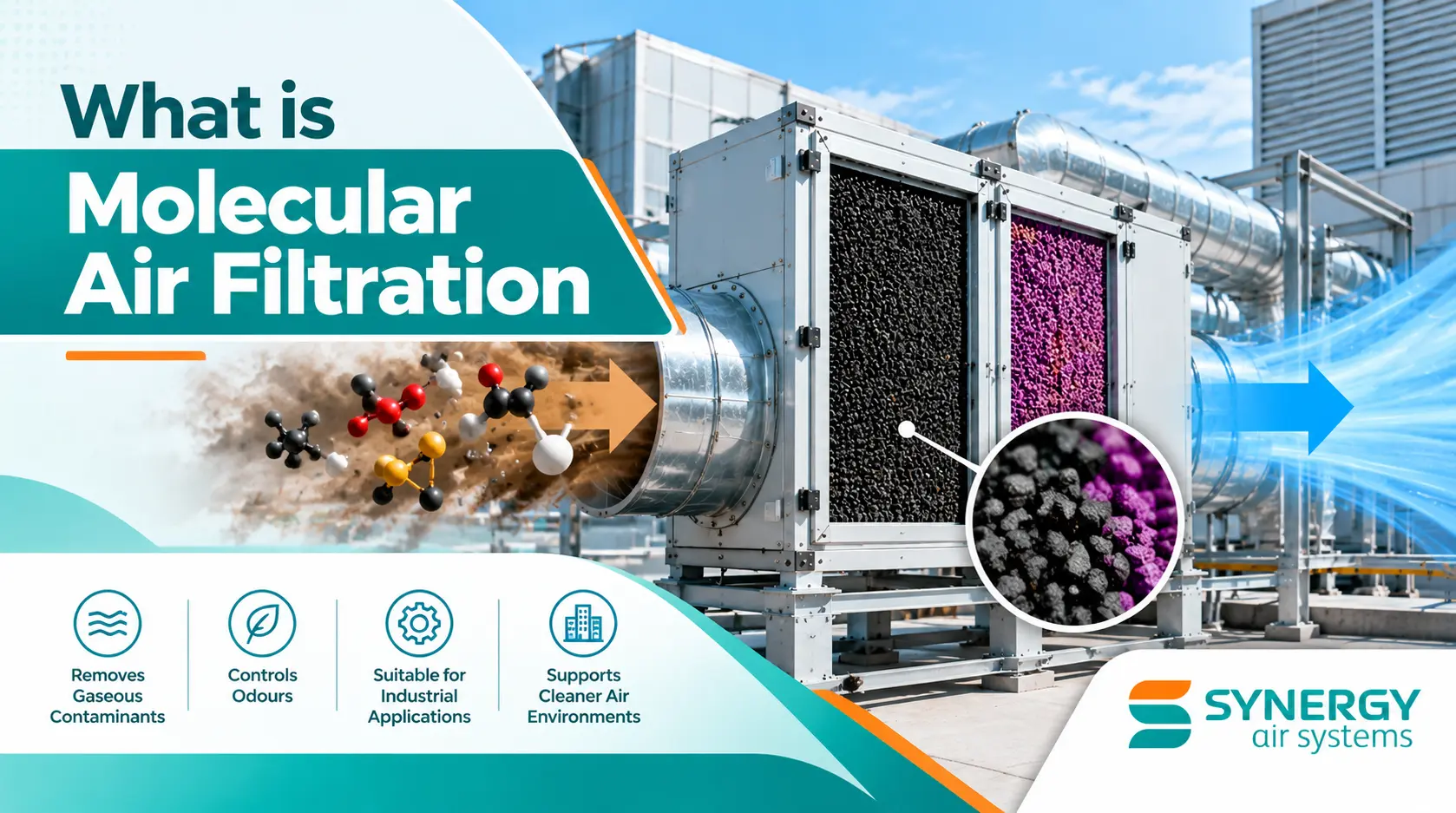
ToggleMolecular air filtration is a method of removing gaseous contaminants, chemical vapours, and odour-causing compounds from air using specially selected filtration media. Unlike conventional particulate filters that capture dust and airborne particles, molecular filtration uses processes such as adsorption and chemisorption to retain or chemically react with specific gas molecules.
This technology is used in industrial facilities, commercial buildings, data centres, pharmaceutical environments, and other locations where airborne chemicals can affect indoor air quality, sensitive equipment, or industrial processes. The effectiveness of a molecular filtration system depends on the contaminants present, the filtration media selected, and the operating conditions.
What Is Molecular Air Filtration?
Molecular air filtration, also known as gas-phase filtration, is designed to control airborne contaminants that exist as gases or vapours rather than suspended particles.
Common examples include volatile organic compounds (VOCs), hydrogen sulphide, sulphur dioxide, and certain odour-causing compounds. Depending on their properties and concentration, these contaminants may contribute to unpleasant odours, chemical exposure concerns, or corrosion of sensitive equipment.
Standard particulate filters, including HEPA filters, are designed to capture particles. They generally do not remove gaseous contaminants unless they incorporate an appropriate gas-phase treatment medium.
Molecular filtration addresses this limitation by using materials selected for their ability to interact with particular gases. These materials may physically adsorb contaminants onto their surfaces or chemically react with them.
The technology is particularly relevant where controlling gaseous contamination is important alongside conventional ventilation and particulate filtration.
How Does Molecular Air Filtration Work?
Molecular air filtration works by passing contaminated air through a medium that can capture or chemically react with selected gas molecules. The process depends on the properties of the contaminant and the chemistry of the filtration material.
A typical system involves three main stages:
- Air movement: A fan or air-handling system moves contaminated air through the filtration equipment.
- Contaminant interaction: Gas molecules contact the filtration media and are retained through adsorption or react with chemically active materials through chemisorption.
- Treated air delivery: Air leaves the filtration section with a reduced concentration of the targeted contaminants, provided the system is correctly designed and operating within its intended limits.
The filtration media must be selected for the actual contaminant profile. A medium suitable for one gas may perform poorly against another, so a general-purpose filter should not be assumed to remove every airborne chemical.
Adsorption and Chemisorption
Adsorption and chemisorption are two important mechanisms used in molecular air filtration.
Adsorption occurs when gas molecules accumulate on the surface of a material. Activated carbon is widely used because its porous structure provides a large internal surface area for retaining many organic vapours and odour-causing compounds.
Chemisorption involves chemical interactions or reactions between a contaminant and a reactive filtration medium. Specially treated media may be used to target selected corrosive gases, reactive compounds, and other pollutants.
The appropriate mechanism depends on the contaminant. Some applications benefit from physical adsorption, while others require chemically reactive media. Facilities dealing with multiple types of gases may need a combination of filtration materials.
How Do Molecular Filtration Media Remove Gaseous Contaminants?
Molecular filtration media are selected according to the chemical characteristics of the gases being treated.
For example, activated carbon may adsorb suitable organic vapours, while impregnated media can provide additional chemical reactivity for selected compounds. Potassium permanganate-based media are used in certain applications involving reactive gases and odour-causing substances.
As air passes through the media, contaminants interact with the available adsorption sites or reactive chemicals. Over time, the media’s remaining capacity decreases as it accumulates contaminants or undergoes chemical reactions.
The service life of the media depends on contaminant concentration, airflow, temperature, humidity, and the specific chemical formulation. Monitoring and appropriate replacement are therefore important parts of maintaining system performance.
What Contaminants Can Molecular Air Filtration Remove?
Molecular air filtration can target a range of gaseous pollutants, but no single medium is suitable for every contaminant. Selection should be based on the gases identified at the facility and the required treatment objective.
Volatile Organic Compounds (VOCs)
Volatile organic compounds are carbon-containing chemicals that readily evaporate into the air. They may originate from solvents, coatings, adhesives, cleaning products, manufacturing processes, and other industrial activities.
Some VOCs can contribute to odours or indoor air quality concerns. Their effects vary considerably according to the specific compound and concentration.
Activated carbon is commonly used to adsorb many organic vapours. However, performance varies between compounds, and humidity, temperature, concentration, and contact time can affect removal. Certain VOCs may require specialised media or another treatment technology.
Odour-Causing Compounds and Other Gaseous Pollutants
Industrial odours can originate from chemical processing, wastewater treatment, waste handling, manufacturing, and other operations.
Relevant contaminants may include:
- Hydrogen sulphide (H₂S): A toxic gas with a characteristic rotten-egg odour that can also contribute to corrosion.
- Sulphur dioxide (SO₂): A reactive gas associated with combustion and certain industrial processes.
- Ammonia (NH₃): A pungent gas used in several industrial processes and refrigeration applications.
- Selected organic vapours: Compounds that may contribute to odours and require appropriate adsorption media.
- Other corrosive gases: Depending on the facility, contaminants such as chlorine and nitrogen oxides may require specialised treatment.
The correct solution depends on the specific gas, its concentration, the airflow being treated, and whether the main objective is odour reduction, corrosion control, exposure reduction, or another requirement.
Where concentrations are high or an accidental toxic gas release is possible, molecular filtration should not be treated as a substitute for appropriate containment, ventilation, gas detection, emergency planning, and dedicated scrubbing systems.
What Types of Molecular Air Filtration Media Are Used?
Different filtration materials serve different purposes. The following are common options for gas-phase filtration.
Activated Carbon Filtration
Activated carbon is a porous material with a large internal surface area. Its structure allows suitable gas molecules to accumulate on the available surfaces through adsorption.
It is commonly used for selected VOCs, organic vapours, and odour-causing compounds in commercial and industrial air treatment applications.
Activated carbon performance depends on the chemical properties of the target contaminant, the carbon formulation, airflow, contact time, humidity, and the concentration of competing substances.
Activated carbon should not be considered a universal solution for every corrosive or toxic gas. Some contaminants require chemically impregnated media or a different treatment process.
Impregnated Activated Carbon
Impregnated activated carbon contains additional chemicals introduced to improve its ability to treat selected contaminants. The added substances can enable chemical reactions that ordinary activated carbon may not provide effectively.
These media can be useful where a facility needs to control particular reactive gases or compounds that are not adequately addressed through physical adsorption alone.
The impregnation chemistry must match the target contaminant. A medium designed for one class of gases may not be appropriate for another, making contaminant assessment an important step in system selection.
Potassium Permanganate and Other Chemically Reactive Media
Potassium permanganate-based media are used in certain gas-phase filtration applications to react with selected contaminants. The chemical is typically incorporated into a suitable supporting material, such as activated alumina.
Depending on the formulation, these media can be used to treat certain reduced sulphur compounds, nitrogen-containing gases, and other reactive pollutants.
Other chemically treated media may be selected for different target gases. The choice depends on the contaminant chemistry, expected loading, humidity, and required treatment performance.
Because reactive media are consumed or altered during operation, their remaining capacity and replacement requirements should be assessed through an appropriate maintenance or monitoring programme.
Where Is Molecular Air Filtration Used?
Molecular air filtration is useful in environments where gaseous contaminants need to be controlled beyond what conventional particulate filtration can achieve.
Industrial Facilities and Manufacturing
Industrial facilities may generate corrosive gases, chemical vapours, and odour-causing compounds during production, material handling, storage, and waste treatment.
Molecular filtration can be applied to suitable air streams to help control these contaminants. In electrical rooms, control rooms, and process control areas, selected gas-phase filtration systems can also help reduce exposure of sensitive equipment to corrosive gases.
The design should consider the source and concentration of contaminants, airflow patterns, operating conditions, and the required level of protection.
Pharmaceutical and Healthcare Environments
Pharmaceutical production and certain healthcare environments may require control of chemical contaminants in addition to temperature, humidity, ventilation, and airborne particles.
Depending on the application, molecular filtration may help address selected solvent vapours, chemical emissions, and other gaseous contaminants.
However, molecular filtration does not replace the particulate filtration, ventilation, pressure control, or contamination-control measures required for a particular cleanroom or healthcare space. The system must be designed around the facility’s specific operational and regulatory requirements.
Semiconductor Facilities and Data Centres
Semiconductor manufacturing can be sensitive to airborne molecular contaminants that affect materials, processes, or product quality. Molecular filtration may be used to control selected gaseous contaminants in areas requiring specialised environmental management.
Data centres and industrial control rooms face a different concern: corrosive gases can affect electronic components, circuit boards, electrical contacts, and other sensitive hardware.
In these environments, gas-phase filtration can be part of a broader corrosion-control strategy. Depending on the facility, the solution may include contaminant assessment, suitable chemical media, controlled airflow, and corrosion monitoring.
What Are the Benefits of Molecular Air Filtration?
When correctly selected and maintained, molecular air filtration offers several practical benefits.
- Targeted gaseous contaminant control: Appropriate media can reduce concentrations of specific gases and vapours.
- Odour reduction: Suitable filtration materials can help control selected odour-causing compounds.
- Corrosion control: Reducing exposure to certain corrosive gases can help protect sensitive electronics and industrial equipment.
- Support for specialised environments: Molecular filtration can complement other air treatment measures in facilities with specific chemical air quality requirements.
- Integration with HVAC systems: Some molecular filters can be incorporated into compatible air-handling equipment, while other applications require dedicated filtration modules or scrubbers.
These benefits depend on proper system selection, design, commissioning, and ongoing maintenance. Molecular filtration should be treated as one component of an overall air quality management strategy rather than a universal solution for every airborne contaminant.
How Do You Choose the Right Molecular Filtration System?
Selecting a molecular filtration system starts with understanding the contaminants that need to be controlled. Choosing a filter based only on general claims about efficiency may result in poor performance if the media are not suitable for the gases present.
Consider the following factors before selecting a system.
1. Identify the contaminants. Determine which gases or vapours are present, where they originate, and whether their concentrations vary during operation. Air quality testing may be necessary where the contaminant profile is uncertain.
2. Establish the treatment objective. Decide whether the main requirement is odour reduction, corrosion control, control of specific chemical vapours, or another defined air quality objective.
3. Select suitable filtration media. Match the media chemistry to the target contaminants. Activated carbon, impregnated carbon, and other reactive media have different capabilities and limitations.
4. Evaluate airflow and contact time. The airflow rate and the time air spends in contact with the media affect performance. Equipment sizing should account for the actual operating conditions.
5. Consider environmental conditions. Temperature, relative humidity, contaminant concentration, and competing gases can influence the effectiveness and service life of the filtration media.
6. Plan monitoring and maintenance. Establish a method for assessing performance and determining when media replacement is necessary. Depending on the application, this may involve air sampling, laboratory analysis of used media, or corrosion monitoring.
A properly engineered system should be selected using the facility’s requirements and relevant performance data rather than relying on a single filter specification.
Molecular Air Filtration Solutions from Synergy Air Systems
Selecting the right molecular filtration system requires an understanding of the contaminants, the facility’s operating conditions, and the protection required. The solution may involve standard HVAC-integrated filters, dedicated gas-phase filtration modules, chemically reactive media, or specialised scrubbing equipment.
Synergy Air Systems provides gas-phase air filtration solutions for industrial and critical environments, including molecular filtration media, corrosion-control applications, and specialised gas treatment systems. Our services include project assessment, system design, installation, commissioning, and ongoing maintenance support, depending on project requirements.
If your facility is experiencing persistent odours, corrosive gas exposure, or concerns about airborne chemical contaminants, start by identifying the gases present and determining the required treatment objective.
Explore our molecular air filtration systems and gas-phase filtration services to understand the available solutions for your application.
The right filtration strategy begins with the right contaminant assessment. Matching the treatment technology to the actual air quality challenge helps support reliable operation and effective long-term contaminant control.
Frequently Asked Questions
What Is the Difference Between Molecular and Particulate Air Filtration?
Particulate filtration captures airborne particles such as dust, pollen, and other suspended material. Molecular air filtration targets gaseous contaminants and vapours using media that adsorb or chemically react with selected compounds. Some facilities require both technologies to address different air quality concerns.
Does Activated Carbon Remove All Gaseous Pollutants?
No. Activated carbon is effective for many suitable organic vapours and odour-causing compounds, but it does not remove every gas equally well. Some contaminants require specially impregnated media, other reactive filtration materials, or alternative treatment technologies.
How Often Should Molecular Filtration Media Be Replaced?
There is no single replacement interval for every system. Media life depends on the contaminants present, their concentration, airflow, humidity, operating hours, and the media formulation. Performance monitoring, manufacturer guidance, and analysis of used media can help establish an appropriate replacement schedule.
Can Molecular Air Filtration Control Industrial Odours?
Yes, molecular filtration can control selected industrial odours when the filtration media are suitable for the compounds responsible. The appropriate treatment depends on the odour composition, concentration, airflow, and operating conditions. Some applications may require a chemical scrubber or a combination of treatment technologies.
Table of Contents
Toggle