Gas Phase Filtration Pharmaceutical India: Clean Room Air Purity for Drug Manufacturing

Table of Contents
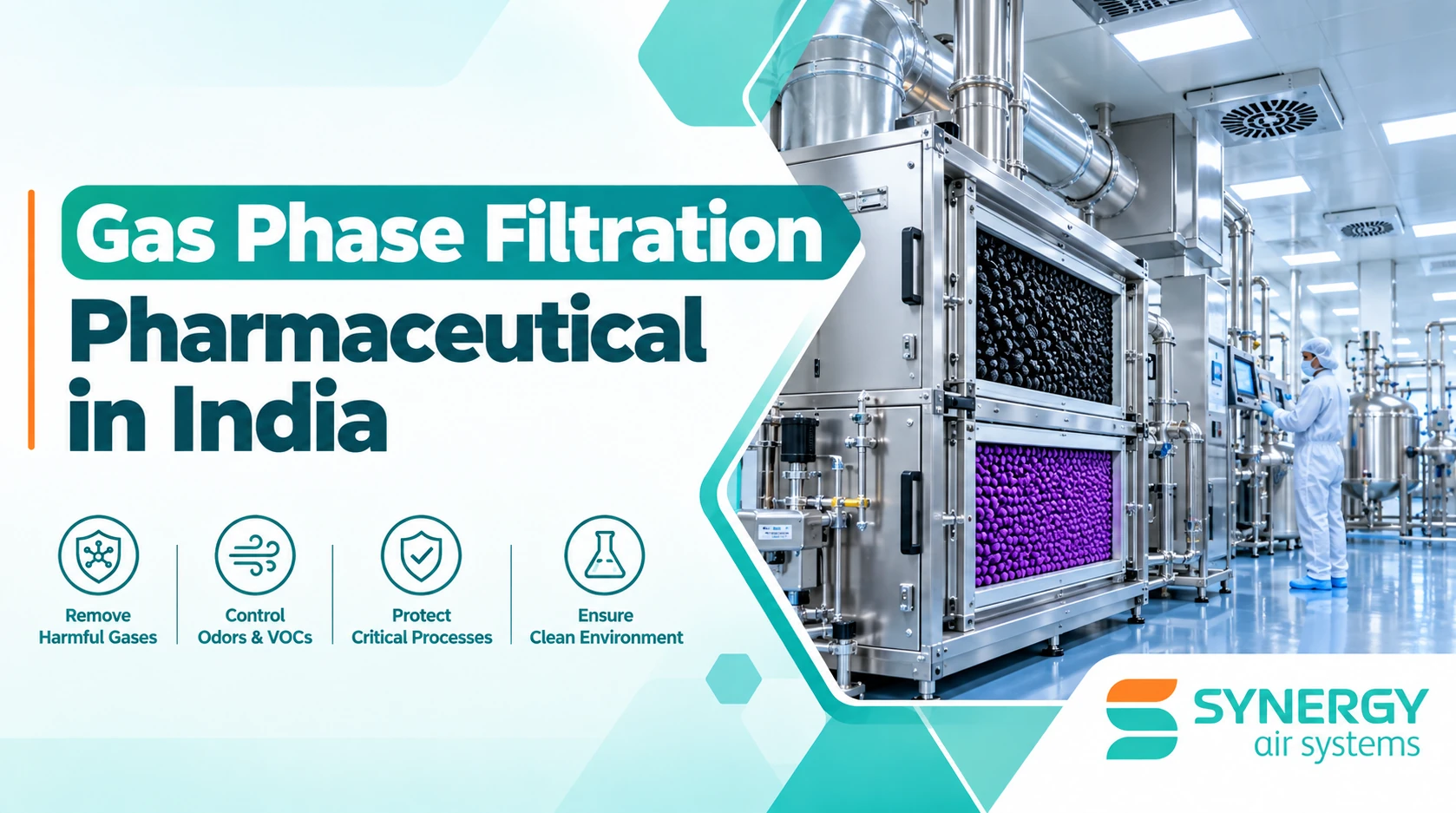
TogglePharmaceutical manufacturing requires strict control of contamination to protect products, processes, equipment, and controlled environments. While particulate filtration addresses airborne particles, Gas Phase Filtration Pharmaceutical India solutions are designed to control gaseous and molecular contaminants that conventional particle filters cannot remove.
In pharmaceutical cleanrooms, gaseous contaminants can come from process chemicals, solvents, cleaning agents, outdoor pollution, industrial emissions, and other sources. Depending on the application, these contaminants may include VOCs, odours, ozone, corrosive gases, and reactive chemical vapours.
A properly selected Molecular Filtration system can provide an additional layer of chemical air purification where gaseous contamination is identified as a risk.
What Is Gas Phase Filtration?
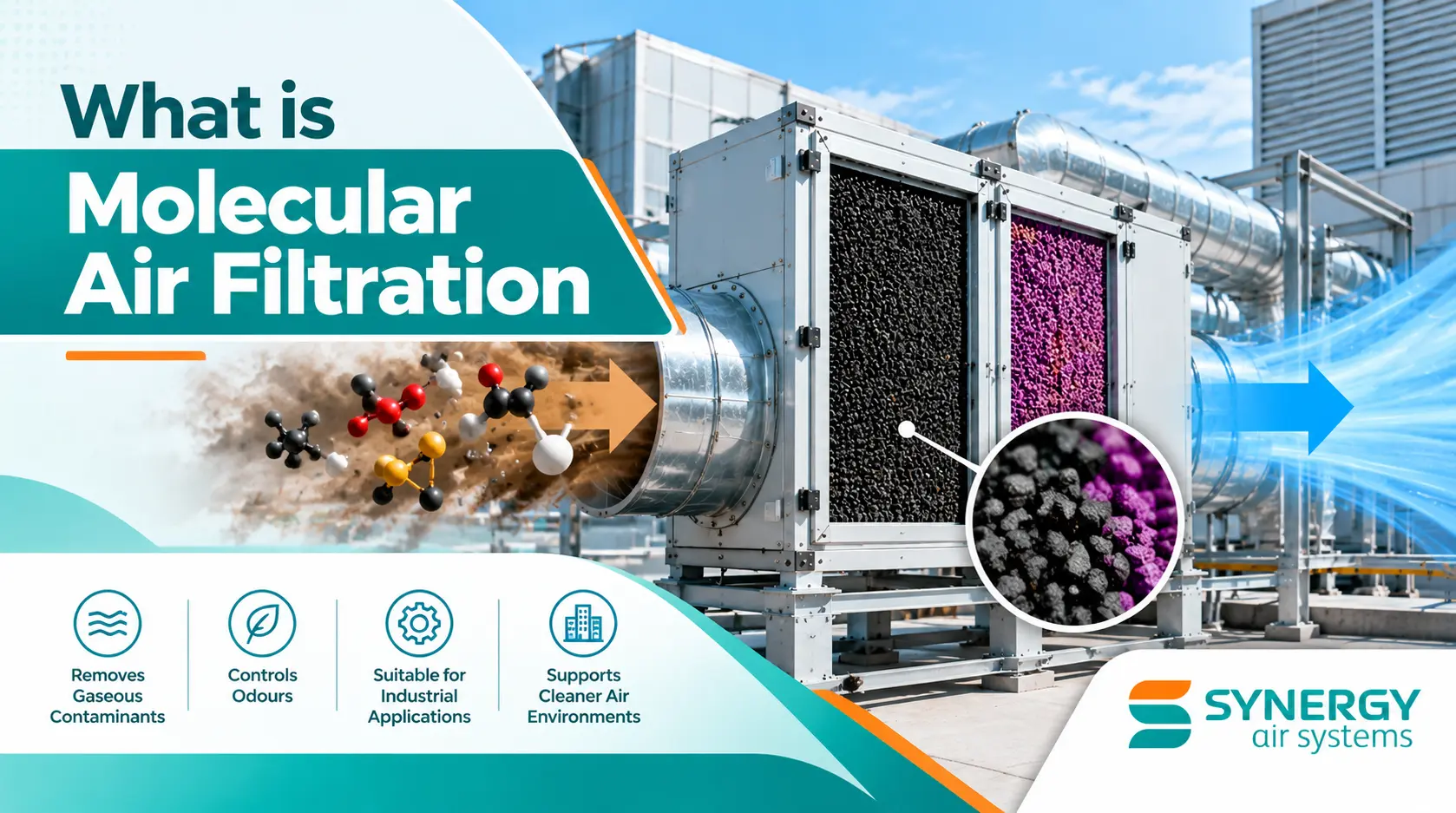
Gas Phase Filtration removes gaseous contaminants from air through mechanisms such as adsorption and chemisorption.
Instead of physically trapping particles, molecular filtration media interact with gas molecules and retain or chemically react with them.
Common media technologies include:
- Activated carbon
- Impregnated activated carbon
- Potassium permanganate media
- Activated alumina-based media
- Blended molecular media
The correct media depends on the contaminant. Activated carbon, for example, is widely used for adsorption of many organic vapours and odour-causing compounds, while chemically treated media can be selected for specific reactive or corrosive gases.
Why Pharmaceutical Facilities Need Molecular Filtration
A pharmaceutical cleanroom can achieve its required particle cleanliness while still having a potential chemical contamination problem.
Gaseous contaminants may affect:
- Pharmaceutical products and raw materials
- Sensitive manufacturing processes
- Laboratory environments
- Equipment and instruments
- Electronic control systems
- Stainless-steel and other exposed surfaces
- Controlled storage areas
This is why chemical contamination should be assessed separately when the manufacturing process or surrounding environment creates a relevant risk.
Gas Phase Filtration is not a replacement for particulate filtration. It addresses a different contamination category.
Synergy Air Systems worked with many Pharmaceutical companies like Kush Synthetics Pvt. Ltd., Hema Laboratories Pvt. Ltd., Vikram Thermo (India) Ltd., Adaptive Ocular Sciences, and many more to solved their Gas Phase Filtration related problems.
Here you will find all our projects for HVAC and Gas Air Phase Filtration
Common Gaseous Contaminants in Pharmaceutical Facilities
The actual contaminant profile varies according to the manufacturing process and site conditions.
VOCs and Solvent Vapours
Pharmaceutical production and laboratory activities can involve solvents and other volatile organic compounds.
Activated carbon is commonly considered for adsorption of many organic vapours, subject to the specific chemical and operating conditions.
Corrosive and Reactive Gases
Acidic, alkaline, sulfur-containing, and other reactive gases can create risks for sensitive equipment and controlled environments.
Chemically treated molecular media may be selected when simple adsorption is not sufficient for the target contaminant.
Ozone
Ozone can originate from outdoor air or specific processes and equipment. Molecular filtration can be considered when ozone exposure is identified as a concern.
Odours and Chemical Vapours
Certain production, cleaning, storage, and waste-handling activities can generate odorous or chemically active vapours.
The appropriate media should be selected according to the compounds actually present rather than relying on a generic odour filter.
Activated Carbon vs. Potassium Permanganate Media
Media selection is one of the most important parts of a Gas Phase Filtration system.
| Media | Typical Application |
|---|---|
| Activated Carbon | Many VOCs, organic vapours and odours |
| Impregnated Carbon | Selected reactive gases and chemical contaminants |
| Potassium Permanganate Media | Selected reactive and corrosive gases |
| Blended Media | Multiple contaminant types |
These are general application categories, not universal performance guarantees. Actual suitability depends on contaminant concentration, airflow, temperature, humidity, media formulation, and other site conditions.
Gas Phase Filtration and Pharmaceutical Cleanrooms
ISO 14644-1 deals with airborne particle cleanliness classification, so achieving a cleanroom particle classification does not automatically demonstrate control of gaseous contaminants.
Where chemical contamination is relevant, the facility should consider the chemical composition of the air separately. ISO 14644-8 provides a framework for assessing air cleanliness by chemical concentration.
Molecular filtration can therefore be considered for:
- Incoming air exposed to external pollution
- Recirculated air in sensitive areas
- Pharmaceutical production environments
- Laboratories
- Chemical handling areas
- Sensitive equipment rooms
- Areas requiring additional chemical contamination control
The exact location and configuration should be determined through the facility’s contamination-control strategy.
How to Select the Right Pharmaceutical Gas Filter
The filter should be selected based on the contaminant, not simply the name or size of the filter.
A practical assessment should establish:
- What contaminant is present?
Identify the chemical or chemical group. - What concentration is expected?
Consider normal and potential peak conditions. - What airflow must be treated?
Filter configuration and media quantity depend on the actual airflow. - What are the temperature and humidity conditions?
These can influence molecular filtration performance. - What needs protection?
The objective may be product protection, process protection, equipment protection, or general chemical air quality. - How will media replacement be determined?
Molecular media have finite capacity and require an appropriate maintenance strategy.
Why Site Assessment Matters
There is no single molecular filter that is suitable for every pharmaceutical facility.
An API manufacturing plant may have a very different contaminant profile from a formulation facility or pharmaceutical laboratory. Similarly, a plant located near chemical or heavy industrial activity may experience different outdoor-air contamination than a facility in a less industrial environment.
A proper assessment should therefore consider:
Contaminant source → chemical identification → concentration → airflow → media selection → filtration system → monitoring and maintenance
This approach helps avoid selecting a generic carbon filter when a chemically treated or application-specific media may be more appropriate.
Gas Phase Filtration for Pharmaceutical Manufacturing in India
India’s pharmaceutical manufacturing sector includes API plants, formulation facilities, laboratories, sterile manufacturing areas, and other specialized production environments.
These facilities may encounter chemical contaminants from internal processes as well as surrounding industrial activity.
For pharmaceutical manufacturers, the objective should not simply be to install a molecular filter. The objective is to identify the chemical contamination risk and engineer the appropriate filtration solution around it.
This is particularly important when sensitive products, processes, instruments, or electronic control systems are involved.
Does Gas Phase Filtration Make a Cleanroom GMP Compliant?
No.
Gas Phase Filtration can be one component of a pharmaceutical contamination-control strategy, but installing molecular filtration alone does not establish GMP compliance.
The complete facility must be designed, operated, monitored, maintained, and documented according to applicable pharmaceutical requirements.
The filtration system should support the facility’s overall contamination-control objectives rather than being treated as a standalone compliance measure.
FAQ
What is Gas Phase Filtration in pharmaceutical manufacturing?
Gas Phase Filtration removes gaseous and molecular contaminants from air using media such as activated carbon and chemically treated molecular filtration media.
Is Gas Phase Filtration the same as HEPA filtration?
No. HEPA filtration primarily removes airborne particles, while Gas Phase Filtration targets gaseous contaminants.
Which media are used for pharmaceutical gas filtration?
Depending on the contaminant, systems may use activated carbon, impregnated carbon, potassium-permanganate-treated media, alumina-based media, or blended molecular media.
Can molecular filtration remove VOCs?
Activated carbon is commonly used for adsorption of many VOCs and organic vapours. Actual suitability depends on the specific compound and operating conditions.
Is Gas Phase Filtration required in every pharmaceutical cleanroom?
No. It should be considered when the facility’s process, environment, or risk assessment identifies gaseous contamination as a concern.
How is the correct molecular filter selected?
The selection should be based on the contaminant type, concentration, airflow, temperature, humidity, protection objective, media chemistry, and expected operating conditions.
Table of Contents
Toggle