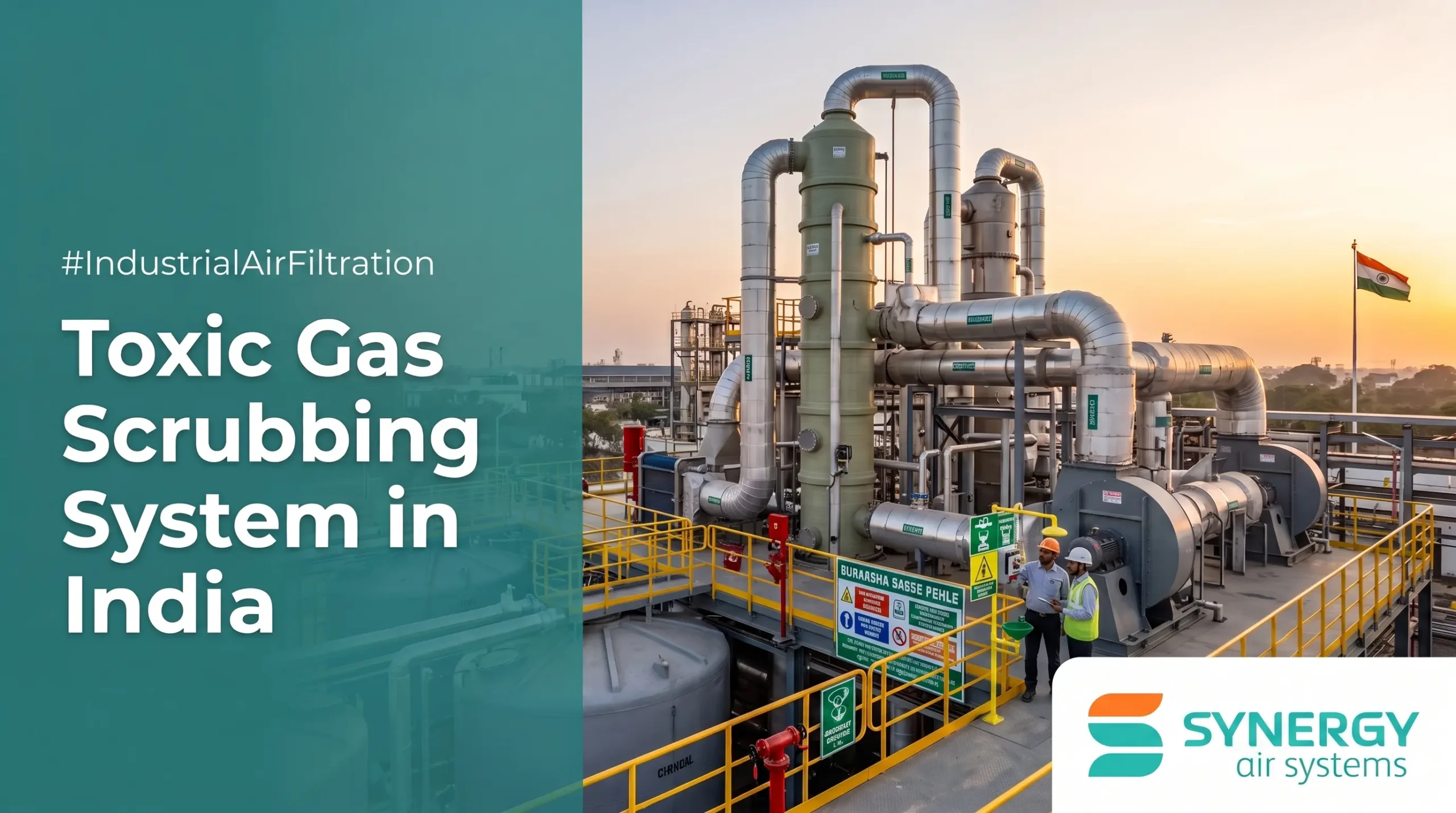
Toxic Gas Scrubbing System India: Emergency & Continuous Scrubbing Solutions

Table of Contents
ToggleA toxic gas scrubbing system India solution is designed to capture, neutralise, or chemically remove hazardous gases from industrial air streams before they can create unacceptable risks for people, equipment, processes, or the surrounding environment. Depending on the gas, concentration, airflow, operating conditions, and application, industries may consider wet scrubbers, dry scrubbers, packed bed scrubbers, emergency scrubbers, or chemical media-based systems.
For facilities handling gases such as chlorine, ammonia, sulphur dioxide (SO₂), hydrogen chloride (HCl), and other corrosive or hazardous contaminants, system selection should be based on actual gas characteristics and the required operating scenario rather than a one-size-fits-all design.
What Is a Toxic Gas Scrubbing System?
A toxic gas scrubber is an air pollution control or gas-treatment system that removes targeted gaseous contaminants from an exhaust, ventilation, process, or emergency air stream.
The removal mechanism depends on the technology. Wet systems bring contaminated gas into contact with a liquid scrubbing medium, while dry systems use specially selected chemical media to adsorb or chemically react with contaminants.
For emergency applications, the objective can be rapid containment of an accidental release. For continuous applications, the objective may be ongoing treatment of process emissions or protection of occupied and critical areas.
Synergy Air Systems describes its toxic-gas solutions as systems designed for hazardous substances including chlorine, sulphur dioxide, hydrogen sulphide and ammonia, with applications including water treatment, chemical manufacturing and heavy industrial facilities.
Why Toxic Gas Scrubbing Matters in Industrial Facilities
Industrial plants can handle chemicals under conditions where an uncontrolled release may present serious safety and operational concerns. Gas treatment therefore needs to be considered alongside ventilation, detection, containment, emergency response and other safety measures.
CPCB states that it works with State Pollution Control Boards and Pollution Control Committees to implement India’s air-pollution control framework, while SPCBs/PCCs monitor compliance with applicable emission and effluent standards.
A properly engineered scrubbing system can support objectives such as:
- Controlling hazardous process gases
- Reducing exposure to corrosive or toxic contaminants
- Supporting emergency containment strategies
- Protecting sensitive equipment from corrosive gases
- Treating selected industrial exhaust streams
- Supporting an overall industrial safety strategy
The exact performance requirement must be established from the facility’s gas profile, airflow, concentration, temperature, required outlet condition and applicable requirements.
Emergency vs Continuous Toxic Gas Scrubbing
One of the most important decisions is determining whether the system is required for emergency gas release protection, continuous treatment, or both.
Emergency Scrubber
An emergency scrubber is designed for an abnormal event such as a storage-cylinder failure, process leak or other accidental release.
The system may be connected to a dedicated enclosure, room, storage area or ventilation network. Its engineering must consider the potential release scenario, available airflow, containment volume, target gas, required response and downstream treatment.
Synergy Air Systems specifically describes emergency toxic-gas scrubbing networks for sudden releases involving gases such as chlorine, ammonia and sulphur dioxide.
Continuous Scrubbing
Continuous systems operate during normal production or ventilation conditions. They can be used where a process continuously produces or releases a gaseous contaminant that needs treatment.
The design emphasis is different from an emergency system. Engineers need to consider sustained airflow, contaminant concentration, operating hours, media or reagent consumption, pressure drop, maintenance and the expected service life of treatment components.
For some facilities, emergency and continuous treatment can form complementary layers of protection.
Wet Scrubber Systems
A wet scrubber uses a liquid to contact the contaminated gas. Depending on the chemistry, the liquid may absorb the target gas or chemically react with it.
Wet scrubbing can be considered for suitable water-soluble or chemically reactive gases. The design may incorporate equipment such as spray sections, packed sections, mist eliminators, pumps, tanks and chemical dosing arrangements.
For chemical neutralisation, the scrubbing liquid can be selected or conditioned to promote removal of the target contaminant.
Wet systems can, however, create a liquid stream that requires appropriate handling and treatment. The process should therefore consider not only gas removal but also wastewater, spent chemical and operating requirements.
CPCB documentation includes industrial examples in which process gases are routed to scrubbers and scrubbed liquids are subsequently directed toward process reuse or wastewater treatment, depending on the application.
Dry Scrubber Systems
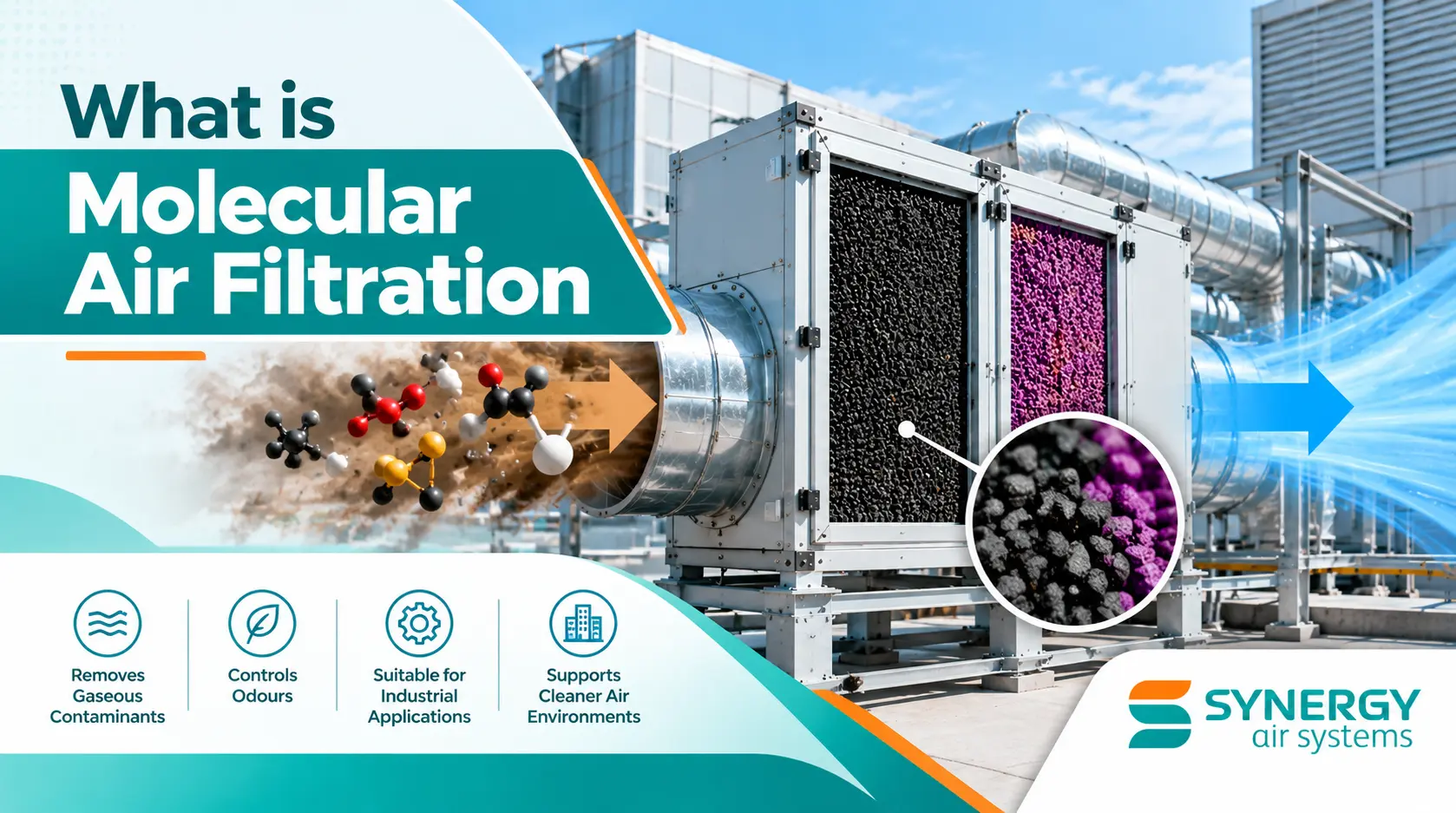
A dry scrubber uses solid chemical media rather than a circulating liquid. Gas-phase filtration systems can use adsorbent or chemically reactive media selected for specific contaminants.
Dry systems can be particularly useful for applications involving protection of control rooms, electrical rooms, sensitive electronics and other enclosed environments where continuous molecular contamination control is required.
Synergy Air Systems states that its gas-phase solutions use chemical media and chemisorption systems for corrosive, toxic and odorous gases. Its service offering includes custom dry-scrubbing systems and deep-bed scrubbers.
A key consideration with dry media is breakthrough or media exhaustion. Monitoring, replacement planning and appropriate disposal should form part of the lifecycle strategy.
Packed Bed Scrubber and Chemical Neutralisation
A packed bed scrubber increases gas-liquid contact by passing the gas through a packed section while the scrubbing liquid flows across the packing.
This increased contact area can support mass transfer between the gas and liquid. The appropriate packing, liquid chemistry, airflow and operating conditions depend on the target contaminant and application.
Chemical neutralisation is another important concept. Rather than relying solely on physical absorption, the liquid or solid media can be selected to react with the contaminant and convert it into a less hazardous chemical form.
System design should therefore start with the actual contaminant chemistry rather than simply selecting a scrubber based on airflow.
Toxic Gases Commonly Requiring Scrubbing
Chlorine
Chlorine (Cl₂) can be encountered in water treatment, chemical processing and other industrial applications. An accidental chlorine release can require a dedicated emergency response strategy.
A chlorine scrubbing system may use wet chemical scrubbing or appropriately engineered dry chemical media depending on the application. The design should account for the potential release quantity, concentration, room or enclosure volume, ventilation and required treatment performance.
Ammonia
Ammonia (NH₃) is used in several industrial processes, including refrigeration and chemical manufacturing. Its treatment requirements depend on concentration, airflow, temperature and the release scenario.
For an ammonia application, the engineer should evaluate whether continuous process treatment, emergency containment or an integrated strategy is appropriate.
Sulphur Dioxide
Sulphur dioxide (SO₂) is an acidic gas that can occur in industrial processes and combustion-related applications.
Scrubbing technology can be selected to suit the concentration and operating conditions. Synergy Air Systems identifies SO₂ among the corrosive gases addressed by its gas-phase filtration and chemical media solutions.
Hydrogen Chloride
Hydrogen chloride (HCl) is a highly reactive acidic gas associated with certain chemical and industrial processes.
A suitable system may use liquid absorption and chemical neutralisation where wet scrubbing is appropriate. Materials of construction, corrosion resistance, chemical compatibility and downstream liquid handling become important engineering considerations.
Key Factors When Selecting a Toxic Gas Scrubbing System in India
Before purchasing a toxic gas scrubbing system India solution, industrial buyers should provide the system designer with as much process information as possible.
Important parameters include:
- Target gas: Identify every significant contaminant rather than only the primary gas.
- Gas concentration: Normal, peak and emergency concentrations may be different.
- Airflow: Determine the required treatment airflow in the relevant operating condition.
- Temperature and humidity: These can influence chemical reactions and media performance.
- Release scenario: Define whether the system is for continuous emissions, accidental releases or both.
- Required outlet condition: Establish the applicable performance objective.
- Materials of construction: Consider corrosion and chemical compatibility.
- Pressure drop: Confirm that fans and ventilation equipment can handle the system resistance.
- Monitoring: Consider differential pressure, gas detection and media condition monitoring where appropriate.
- Maintenance: Plan access for inspection, reagent replenishment or media replacement.
Synergy Air Systems’ deep-bed scrubber engineering approach, for example, considers gas analysis, system modelling, fabrication, commissioning and lifecycle support.
How a Toxic Gas Scrubbing Project Is Engineered
A reliable project generally begins with site and process information, not with a standard catalogue selection.
The engineering process can include:
1. Gas Characterisation
Identify the gases, concentrations, temperature, humidity and airflow.
2. Application Assessment
Determine whether the requirement is emergency protection, continuous emission control, room protection or a combination.
3. Technology Selection
Compare wet scrubbing, dry chemical media, packed-bed configurations and other suitable technologies.
4. System Sizing
Determine airflow, contact conditions, media or liquid requirements, fan capacity, pressure drop and equipment dimensions.
5. Integration
Connect the system with ventilation, ductwork, controls, alarms, gas detection and other relevant plant systems.
6. Commissioning and Maintenance
Verify operation and establish inspection, media/reagent replacement and monitoring procedures.
Industrial Applications
Toxic gas scrubbing can be relevant across multiple sectors, including:
- Chemical manufacturing
- Water and wastewater treatment
- Fertiliser facilities
- Pharmaceutical manufacturing
- Oil and gas
- Petrochemical plants
- Pulp and paper
- Industrial utilities
- Process plants
- Chemical storage areas
- Control rooms and critical electronic spaces
CPCB identifies chemical-industry sectors including fertilisers, chlor-alkali, pharmaceuticals, petrochemicals, pesticides and inorganic chemicals within its industrial pollution-control activities.
Compliance and Industrial Safety Considerations
A scrubber should not be treated as a standalone safety measure. Toxic-gas management normally needs to work with the facility’s broader safety system, including leak detection, ventilation, containment, emergency procedures, maintenance and personal protective equipment.
Applicable Indian requirements can vary by industry, chemical, installation and state. CPCB notes that SPCBs/PCCs issue consents to establish and operate and monitor applicable emissions and effluent standards.
Facilities should therefore confirm applicable requirements with their environmental, process-safety and regulatory teams before finalising system specifications.
Why Consider Synergy Air Systems?
Synergy Air Systems provides gas-phase air filtration and industrial gas-treatment solutions, including emergency toxic gas scrubbing, chemical media, deep-bed scrubbers and corrosion monitoring. Its published services describe engineering for corrosive and toxic gases, environmental toxicity assessment and custom dry-scrubbing systems.
Its gas-phase filtration portfolio also covers toxic-gas applications involving chlorine, sulphur dioxide and ammonia, alongside broader molecular filtration and corrosion-control requirements.
For an industrial buyer, the most useful starting point is to provide the gas composition, concentration, airflow, process conditions, location and whether the requirement is emergency or continuous. This allows the engineering team to assess the appropriate treatment approach rather than recommending equipment based on incomplete information.
FAQs
What is a toxic gas scrubbing system?
A toxic gas scrubbing system removes or neutralises selected hazardous gases from an air or process stream. Depending on the application, it may use a liquid scrubbing solution, chemical media or another gas-treatment technology.
What is the difference between a wet scrubber and a dry scrubber?
A wet scrubber uses a liquid to absorb or chemically react with gases. A dry scrubber uses solid chemical or adsorbent media. The appropriate option depends on the gas, concentration, airflow, operating conditions and application.
What is an emergency gas scrubber?
An emergency gas scrubber is designed to manage an accidental release of a hazardous gas. It can form part of an emergency containment strategy for areas handling gases such as chlorine, ammonia or sulphur dioxide.
Can one scrubber remove chlorine, ammonia, SO₂ and HCl?
Not necessarily. Different gases have different chemical properties and may require different scrubbing chemistry or media. A multi-gas system may be possible, but it must be engineered around the actual contaminant mixture and operating conditions.
What information is needed to size a toxic gas scrubber?
Important information includes gas type, concentration, airflow, temperature, humidity, pressure, normal and emergency operating conditions, required treatment performance, installation location and available utilities.
Is a packed bed scrubber suitable for every toxic gas?
No. A packed bed scrubber is one possible wet-scrubbing configuration. Suitability depends on gas solubility, chemical reaction, liquid chemistry, mass-transfer requirements and process conditions.
Are toxic gas scrubbers only used during emergencies?
No. Scrubbing systems can be designed for continuous process emissions, room air treatment, corrosion control, emergency release mitigation or combinations of these applications.
Does a dry scrubber generate wastewater?
Dry systems generally do not use a circulating scrubbing liquid, so they avoid the conventional wastewater stream associated with wet scrubbing. However, exhausted chemical media may require appropriate handling and disposal depending on what it has captured.
Conclusion
Selecting a toxic gas scrubbing system India solution requires more than choosing a scrubber by name. The right technology depends on the target gas, concentration, airflow, operating conditions, required treatment performance and whether the application is continuous, emergency or both.
Wet scrubbers, dry scrubbers, packed bed systems and chemical-media solutions each have different strengths. For hazardous gases such as chlorine, ammonia, sulphur dioxide and hydrogen chloride, a site-specific engineering assessment is the best starting point.
For industrial facilities evaluating emergency or continuous toxic-gas control, Synergy Air Systems provides gas-phase filtration and scrubbing solutions that can be assessed against the facility’s specific requirements.
Table of Contents
Toggle