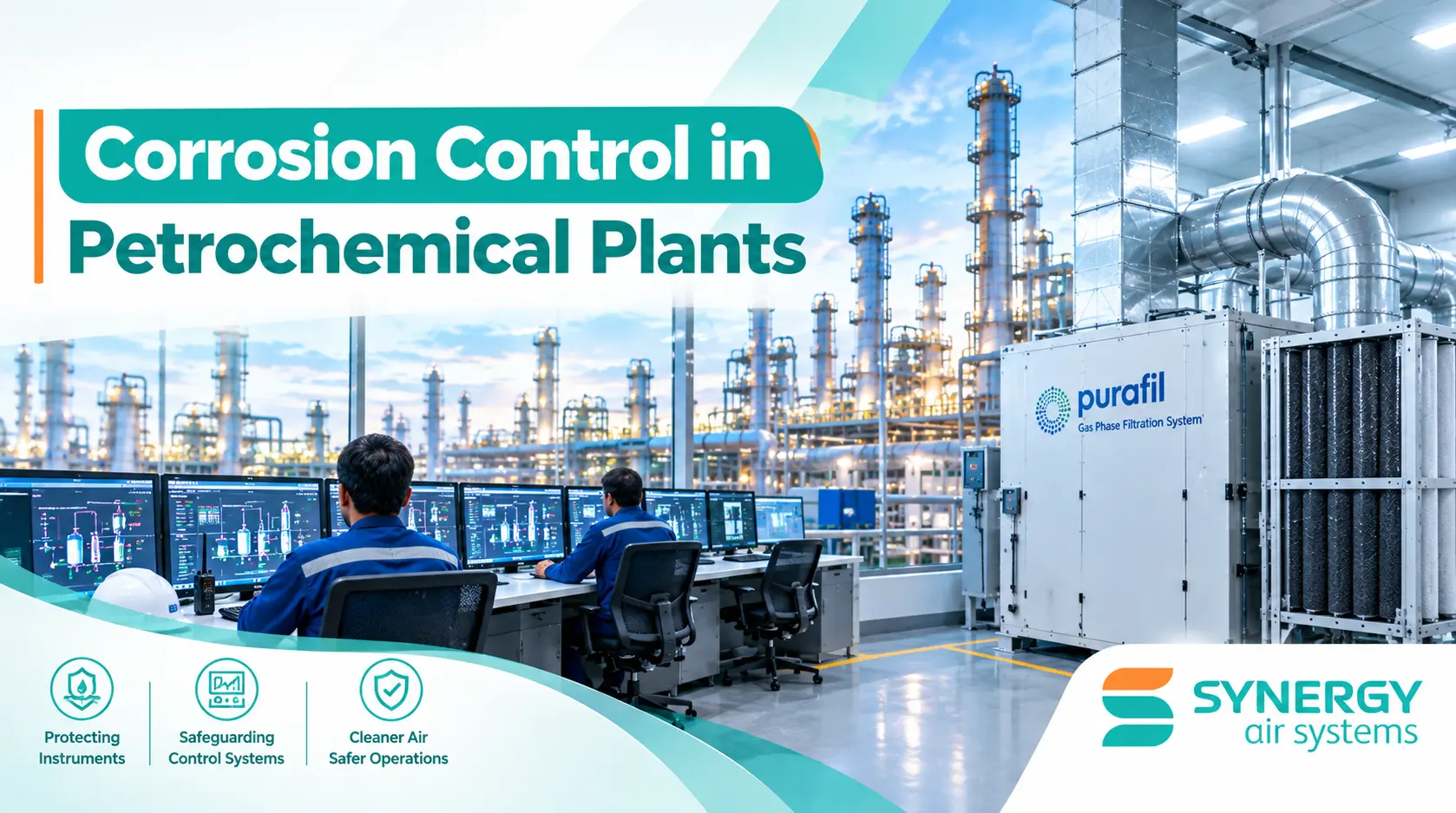
Corrosion Control Petrochemical Plant: Protecting Instruments & Control Systems

Table of Contents
ToggleA Corrosion Control Petrochemical Plant strategy is not limited to protecting pipes, tanks, or structural steel. In many petrochemical facilities, corrosive gases can also enter instrument shelters, control rooms, electrical rooms, and equipment enclosures where sensitive electronic systems operate.
Hydrogen sulfide (H₂S), sulfur dioxide (SO₂), chlorine compounds, nitrogen oxides, hydrocarbons, and other airborne contaminants can contribute to electronic corrosion. The result may be oxidation of circuit-board components, conductive deposits, intermittent faults, communication problems, and premature failure of electronic equipment.
For facility managers, instrumentation engineers, electrical engineers, MEP consultants, and maintenance teams, the challenge is therefore more specific: how do you prevent corrosive gases from reaching sensitive electronic systems in the first place?
Gas Phase Filtration provides one important engineering approach. By treating contaminated air with appropriately selected adsorption or chemisorption media, facilities can reduce gaseous contaminants before they reach critical equipment.
Why Is Corrosion Control Important in a Petrochemical Plant?
A petrochemical plant contains numerous electronic systems that must operate continuously in an environment where process gases, combustion products, chemical vapours, and outdoor pollutants may be present.
Unlike conventional corrosion that is easily visible on exposed metal surfaces, electronic corrosion can develop inside sensitive equipment with relatively little warning.
A PLC panel, DCS cabinet, switchgear assembly, analyser, communication system, or instrumentation circuit board may appear operational while corrosive contaminants are gradually affecting its components.
This makes environmental control particularly important around:
- DCS rooms
- Instrument shelters
- PLC panels
- Electrical control rooms
- Analyzer shelters
- MCC rooms
- Substations
- Telecom and communication rooms
- Server and automation rooms
- Control system enclosures
Corrosive gases can enter these areas through outside-air intakes, door openings, cable penetrations, building leakage, or inadequate pressurization arrangements.
Once inside, the contaminants may interact with moisture and metal surfaces, creating conditions that promote corrosion.
What Causes Electronic Corrosion in Petrochemical Facilities?
Electronic corrosion is influenced by more than simply the presence of a corrosive gas.
The actual risk depends on the combination of:
- Contaminant type
- Contaminant concentration
- Exposure duration
- Temperature
- Relative humidity
- Air movement
- Equipment sensitivity
- Enclosure integrity
- Room pressurization
- Filtration performance
- Maintenance practices
For example, H₂S may be present at one location while SO₂, chlorine compounds, or mixed sulfur-containing contaminants may dominate another. A filtration system designed for one contaminant should not automatically be assumed to provide equivalent protection against every other gas.
This is why Corrosion Control should begin with identifying the actual contaminant environment rather than selecting a filter based only on the name of the industry.
Which Gases Can Affect Petrochemical Plant Electronics?
Petrochemical facilities can experience complex mixtures of gaseous contaminants. Depending on the process, location, and surrounding environment, relevant contaminants may include H₂S, SO₂, chlorine, ozone, VOCs, hydrocarbons, ammonia, and other reactive gases.
H₂S
Hydrogen sulfide is particularly relevant in oil and gas and petrochemical environments.
Even where process containment is effective, low-level fugitive emissions or contaminated outdoor air can create an environmental exposure concern for sensitive equipment.
SO₂ and Sulfur-Containing Compounds
Sulfur dioxide and other sulfur-containing contaminants can contribute to corrosive conditions around electronic equipment.
Their importance depends on the site’s processes, combustion sources, neighbouring industrial activity, and atmospheric conditions.
Chlorine and Reactive Halogen Compounds
Where chlorine or chlorine-containing chemicals are used or stored, accidental releases, fugitive emissions, or contaminated air can become an environmental concern for equipment rooms.
VOCs and Hydrocarbon Vapours
Not every VOC is equally corrosive to electronics. However, some organic vapours can create odour, contamination, or material compatibility concerns and may require adsorption-based treatment depending on their characteristics.
The key point is that gas-phase filtration must be designed around the actual contaminant profile.
How Does Gas Phase Filtration Control Corrosive Gases?
Gas Phase Filtration uses specially selected media to capture or react with gaseous contaminants.
The two fundamental mechanisms are adsorption and chemisorption.
Physical Adsorption
In physical adsorption, gas molecules are attracted to the surface and pore structure of an adsorbent.
Activated carbon is a widely used physical adsorbent because its highly developed pore structure provides substantial surface area for capturing certain gaseous contaminants.
Physical adsorption is generally reversible and is influenced by factors such as temperature, concentration, humidity, contaminant characteristics, and media properties.
Chemisorption
Chemisorption involves a chemical reaction between the contaminant and a reactive component within the filtration media.
Impregnated carbon and impregnated alumina-based media can be engineered for specific classes of gaseous contaminants.
Unlike simple physical adsorption, chemisorption is generally associated with an irreversible reaction in which the reactive component of the media is consumed.
This distinction matters in petrochemical applications because the correct media depends on the contaminant chemistry.
ASHRAE identifies physical adsorption and chemisorption as the primary processes used in gas-phase contaminant filtration and notes that complex gas mixtures may require application-specific evaluation and testing.
Activated Carbon vs Impregnated Media
Choosing between standard activated carbon and chemically impregnated media should not be treated as a simple product-selection exercise.
Activated Carbon
Activated carbon can be useful for many organic vapours and selected gaseous contaminants through physical adsorption.
Its suitability depends on the contaminant’s molecular characteristics and the operating conditions.
Impregnated Carbon
Impregnated carbon contains additional chemical treatment intended to improve its reaction with specific contaminants.
It may therefore be considered where reactive inorganic gases or other contaminants are not adequately addressed by ordinary physical adsorption.
Activated Alumina-Based Media
Activated alumina can be used as a substrate for chemically reactive media. Impregnated alumina formulations are available for specific contaminant categories.
The correct choice depends on the contaminant chemistry rather than simply choosing whichever medium has the largest amount of carbon.
ASHRAE notes that chemisorbent media may use porous substrates such as activated alumina, zeolite, or carbon with chemical reactants incorporated into or applied to the substrate.
How Does a Petrochemical Plant Protect a DCS Room?
A DCS Room contains control hardware responsible for monitoring and managing critical plant processes. Protecting the room from contaminated outdoor air can therefore form part of the facility’s environmental protection strategy.
A typical gas-phase corrosion-control arrangement may involve:
- Controlling the source of contaminated air where practical.
- Maintaining suitable room pressurization.
- Treating incoming or recirculated air with gas-phase filtration.
- Selecting media according to the contaminant profile.
- Installing particulate prefiltration upstream of granular media.
- Monitoring relevant environmental conditions.
- Inspecting and replacing filtration media according to an appropriate maintenance strategy.
The objective is not simply to install a carbon filter.
The objective is to reduce the contaminant load reaching sensitive electronics.
Protecting Instrument Shelters and PLC Panels
An Instrument Shelter can contain transmitters, control equipment, analysers, communication hardware, and other instrumentation that must operate reliably in an industrial environment.
Similarly, a PLC Panel can contain processors, input/output modules, communication interfaces, power supplies, relays, and other electronic components.
These systems can be particularly sensitive to prolonged exposure to corrosive contaminants.
A corrosion-control design may therefore use treated air for the protected enclosure or room while maintaining appropriate positive pressure relative to the surrounding environment.
The exact arrangement depends on the enclosure, airflow requirements, contaminant source, operating philosophy, and equipment layout.
What Is ISA S71.04 and Why Does It Matter?
ISA S71.04 is commonly referenced when discussing airborne contaminants and environmental conditions affecting electronic equipment.
The standard provides a framework for classifying the severity of airborne contaminants in environments containing electronic equipment.
For petrochemical facilities, an environmental assessment against the relevant ISA classification can help engineers establish whether the existing environment presents a concern for sensitive electronics.
It is important, however, not to treat an ISA classification as a substitute for site-specific investigation.
The actual design should consider:
- Where contamination is entering
- Which contaminants are present
- Concentration and exposure conditions
- Temperature and humidity
- Equipment criticality
- Room leakage
- Pressurization
- Existing filtration
- Maintenance history
- Corrosion-monitoring results
Why Room Pressurization Alone May Not Be Enough
Positive pressurization can reduce uncontrolled infiltration when the protected room is maintained at a higher pressure than surrounding areas.
However, pressure control and contaminant removal solve different problems.
Pressurization helps limit the movement of contaminated air into a protected space. Gas Phase Filtration reduces the concentration of gaseous contaminants in the treated air.
For a critical petrochemical control environment, these measures may therefore work together rather than being viewed as alternatives.
A room with positive pressure but contaminated supply air can still introduce contaminants.
Likewise, filtration without adequate control of uncontrolled leakage may not provide the intended level of protection.
Why Humidity Matters in Gas Phase Filtration
Humidity is an important design consideration for molecular filtration.
Water molecules can compete for adsorption sites on physical adsorbents such as activated carbon. As a result, high relative humidity can affect the performance of physical adsorption depending on the contaminant and operating conditions.
Chemisorption can behave differently. Certain chemisorption reactions may benefit from moisture, while excessively dry conditions can negatively affect some chemically reactive media.
Therefore, media performance should be considered over the expected operating range of temperature and humidity rather than under one ideal laboratory condition.
ASHRAE specifically identifies temperature and humidity as important environmental influences on gaseous contaminant removal performance.
Why Particulate Prefiltration Is Important
Gas-phase media should not be expected to perform the job of a particulate filter.
Dust, lint, and other particles can accumulate within granular media and increase pressure drop or restrict airflow.
For this reason, particulate filtration upstream of the gas-phase media is an important part of system design.
This becomes particularly relevant in petrochemical environments where outdoor dust, process-related particles, and other airborne material may enter the air-handling path.
ASHRAE recommends upstream particulate protection for granular gaseous adsorption beds because particle accumulation can obstruct the media and increase pressure drop.
How Should Corrosion Control Be Designed for a Petrochemical Plant?
There is no universal filter configuration that can be specified for every petrochemical facility.
A practical engineering assessment should begin with the following questions.
1. What equipment needs protection?
Identify the critical electronic assets first.
For example:
- DCS cabinets
- PLC panels
- MCC control sections
- Instrumentation
- Analysers
- Communication equipment
- Server systems
- Control-system power supplies
2. What contaminants are present?
Review process information, environmental monitoring, incident history, nearby industrial sources, and available laboratory data.
Potential contaminants may include H₂S, SO₂, chlorine, ozone, VOCs, ammonia, and other reactive gases.
3. Where is contaminated air entering?
Look at:
- Fresh-air intakes
- Door openings
- Cable penetrations
- Louvres
- Building leakage
- Enclosure leakage
- Adjacent process areas
4. What operating conditions must the filtration system handle?
Consider:
- Airflow
- Temperature
- Relative humidity
- Contaminant concentration
- Contaminant mixture
- Operating hours
- Available installation space
- Pressure-drop limitations
5. How will media condition be monitored?
A filtration system requires an appropriate maintenance and replacement strategy.
Depending on the application, this may involve pressure-drop monitoring, contaminant monitoring, media-life calculations, inspection, or other site-specific methods.
Electronic Corrosion Monitoring Adds Valuable Evidence
Visual inspection alone may not provide enough information about the corrosion environment.
Electronic corrosion monitoring and environmental assessment can help establish whether a protected area is actually experiencing corrosive conditions.
Depending on the monitoring methodology, assessments may use corrosion coupons, electronic monitoring devices, environmental sensors, or other analytical techniques.
Monitoring can support decisions such as:
- Whether filtration is required
- Where filtration should be installed
- Whether an existing system is performing as intended
- When investigation is necessary
- Whether environmental conditions are changing
The value of monitoring is that it shifts the discussion from assumptions to measured site conditions.
Common Mistakes in Petrochemical Corrosion Control
Choosing Media Without Identifying the Contaminant
A generic activated-carbon filter should not automatically be considered a solution for every corrosive gas.
Media selection must match the contaminant chemistry and operating conditions.
Focusing Only on Visible Corrosion
Electronic corrosion may develop before obvious external damage becomes visible.
Waiting for circuit boards or electrical contacts to fail is not a good environmental-control strategy.
Ignoring Humidity
Humidity can significantly affect gas-phase adsorption performance.
Neglecting Particulate Filtration
Dust loading can increase pressure drop and affect the operation of granular gas-phase media.
Treating Filter Replacement as an Arbitrary Calendar Activity
Media life depends on the contaminant loading, airflow, media quantity, environmental conditions, and other factors.
Replacement intervals should therefore be established using appropriate engineering and monitoring considerations rather than an unsupported universal number.
Assuming One Media Type Fits Every Plant
Two petrochemical plants can have very different contaminant profiles.
Even different areas within the same plant may require different filtration approaches.
Where Gas Phase Filtration Can Be Applied in a Petrochemical Facility
Gas Phase Filtration may be considered for several protected environments, depending on the site’s contamination profile and engineering requirements.
| Protected Area | Typical Concern |
|---|---|
| DCS Room | Protection of process-control electronics |
| Instrument Shelter | Corrosive outdoor/process-related gases |
| PLC Panel Area | Electronic component degradation |
| Electrical Room | Contaminated air affecting sensitive equipment |
| MCC Room | Protection of control electronics |
| Analyzer Shelter | Sensitive instrumentation and analytical equipment |
| Telecom Room | Protection of communication electronics |
| Control System Enclosure | Localized contamination control |
The final design should be based on the specific equipment, contaminant environment, airflow arrangement, and required protection strategy.
A Practical Corrosion-Control Strategy
For a petrochemical plant, an effective approach can be viewed as a layered system:
Identify → Measure → Control Entry → Filter → Pressurize → Monitor → Maintain
First, identify the sensitive equipment and likely contaminant sources.
Next, measure or characterize the environment where practical.
Then control uncontrolled contaminant entry through enclosure integrity and appropriate room design.
Use Gas Phase Filtration with appropriately selected media to treat the relevant gaseous contaminants.
Maintain suitable pressurization where required.
Finally, monitor the protected environment and maintain the filtration system.
This approach is more robust than treating corrosion control as simply a filter-purchase decision.
Frequently Asked Questions
What is corrosion control in a petrochemical plant?
Corrosion control in a petrochemical plant includes measures used to reduce corrosion risks affecting process equipment, infrastructure, instrumentation, and sensitive electronic systems. For electronic equipment, controlling airborne corrosive contaminants can be an important part of the overall strategy.
Which gases can cause electronic corrosion?
Depending on the facility, gases such as H₂S, SO₂, chlorine-containing compounds, ozone, and other reactive contaminants may contribute to electronic corrosion. The actual risk depends on concentration, exposure duration, humidity, temperature, equipment sensitivity, and other site conditions.
Can activated carbon remove H₂S?
Activated carbon can adsorb certain gases, but H₂S treatment depends on the media formulation, contaminant concentration, humidity, airflow, bed design, and other operating conditions. Chemically treated or impregnated media may be considered for specific reactive contaminants.
Is Gas Phase Filtration the same as particulate filtration?
No. Particulate filters capture particles such as dust and aerosols, while Gas Phase Filtration is designed to remove gaseous contaminants through processes such as adsorption and chemisorption.
Does positive pressure eliminate the need for gas filtration?
Not necessarily. Positive pressure can help reduce uncontrolled infiltration, while Gas Phase Filtration treats contaminants in the air passing through the filtration system. Both can form complementary parts of a contamination-control strategy.
How is the right gas-phase filter selected?
The selection should consider the contaminant type and concentration, airflow, temperature, humidity, required protection level, equipment criticality, available space, pressure-drop limitations, and expected media life. Complex applications may require application-specific testing or evaluation.
Table of Contents
Toggle