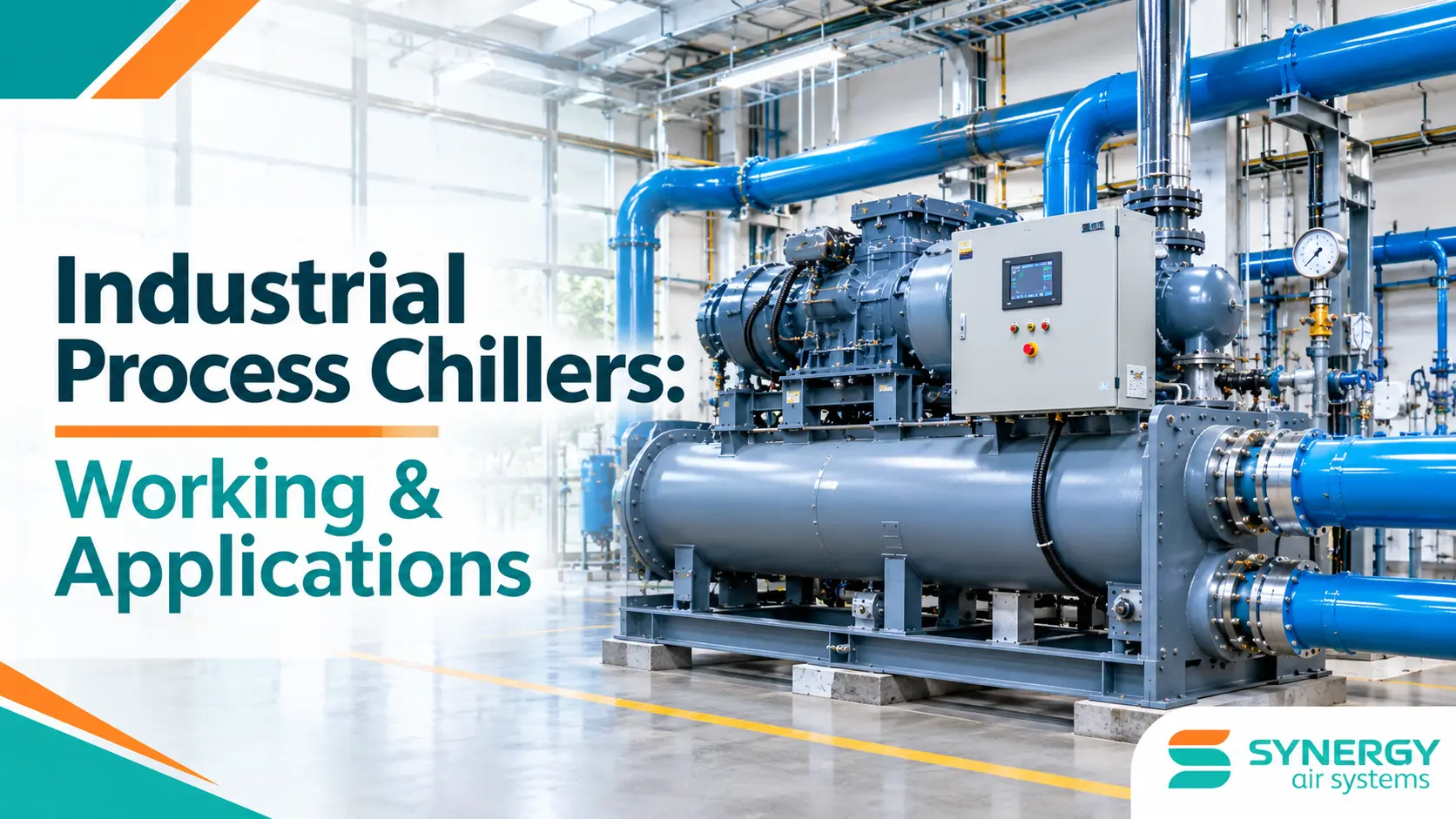
Industrial Process Chillers: Understanding Their Working Principles and Applications

Table of Contents
ToggleIndustrial process chillers play an important role in maintaining controlled temperatures across manufacturing and industrial operations. They remove excess heat from machinery, production equipment, fluids, and industrial processes by circulating chilled water or another cooling fluid. By maintaining the required operating temperature, industrial process chillers help protect equipment, support product quality, and maintain consistent production conditions.
From pharmaceutical manufacturing and chemical processing to plastics production and food processing, industrial chillers are used wherever excess heat needs to be removed reliably. Understanding their working principles, components, types, and applications helps businesses select a suitable cooling solution for their operational requirements.
What Are Industrial Process Chillers?
Industrial process chillers are refrigeration systems designed to remove heat from industrial processes and transfer it to another medium, such as air or cooling water. They generally cool water or a secondary fluid, which is then circulated through heat exchangers, machinery, or production equipment that requires temperature control.
Unlike conventional air conditioning systems, which primarily maintain indoor comfort conditions, industrial process chillers are designed around the cooling requirements of production equipment and industrial operations.
For example, a manufacturing machine may generate considerable heat during continuous operation. If this heat is not removed, it can affect machine performance, product consistency, and equipment reliability. A process chiller provides a controlled cooling supply to help maintain the required operating temperature.
How Do Process Chillers Differ from Comfort Cooling Systems?
Both industrial process chillers and comfort cooling systems use refrigeration principles, but their cooling objectives are different.
- Industrial process chillers: Remove heat generated by machinery, production processes, and industrial equipment.
- Comfort cooling systems: Maintain indoor temperature and humidity conditions for occupants.
Process cooling requirements are often determined by production needs, equipment specifications, operating schedules, and the required temperature range. Some industrial applications require continuous cooling throughout the production cycle, while others experience changing cooling loads depending on the process.
Why Do Industrial Processes Require Controlled Cooling?
Many industrial operations generate heat through mechanical movement, chemical reactions, electrical equipment, friction, or material processing.
Without effective heat removal, excessive temperatures can lead to:
- Inconsistent product quality
- Reduced equipment performance
- Unplanned production interruptions
- Increased wear on machinery
- Temperature-related process variations
- Higher maintenance requirements
Industrial process chillers help manage these conditions by providing a controlled cooling medium at the temperature and flow rate required by the application.
How Do Industrial Process Chillers Work?
Most industrial process chillers use the vapour-compression refrigeration cycle to remove heat from process water. The refrigeration system transfers heat from the chilled fluid to a separate heat-rejection medium, which may be air or water.
The basic vapour-compression refrigeration cycle consists of four main stages: evaporation, compression, condensation, and expansion.
1. Evaporation: Absorbing Heat from Process Water
The process begins in the evaporator, which acts as a heat exchanger between the refrigerant and the water or secondary cooling fluid.
Warm return water enters the evaporator after absorbing heat from industrial equipment. The refrigerant inside the evaporator absorbs this heat and evaporates from a liquid into a vapour.
As heat transfers from the process water to the refrigerant, the water temperature decreases. The chilled water is then circulated back to the industrial process.
2. Compression: Increasing Refrigerant Pressure
The refrigerant vapour leaving the evaporator enters the compressor.
The compressor increases the refrigerant’s pressure and temperature, allowing it to reject the absorbed heat at the condenser.
The compressor is a major energy-consuming component of a vapour-compression chiller. Its type, capacity, operating conditions, and control method influence overall system performance.
3. Condensation: Rejecting Heat
The high-pressure, high-temperature refrigerant vapour moves into the condenser.
Here, the refrigerant releases the heat absorbed from the process water, along with the energy added by the compressor. As it loses heat, the refrigerant condenses and returns to a liquid state.
Depending on the chiller design, heat may be rejected through:
- Air-cooled condensers: Heat is transferred directly to the surrounding air using fans and heat exchanger coils.
- Water-cooled condensers: Heat is transferred to circulating condenser water, which typically carries it to a cooling tower for rejection to the atmosphere.
4. Expansion: Reducing Refrigerant Pressure
The liquid refrigerant passes through an expansion valve or another refrigerant flow-control device.
This component reduces the refrigerant pressure, causing its temperature to decrease before it returns to the evaporator.
The refrigerant can then absorb heat from the returning process water, and the cycle repeats.
How Does Chilled Water Circulate Through Industrial Equipment?
The refrigeration cycle operates within the chiller, while a separate water or secondary-fluid circuit transfers cooling to the industrial process.
The typical sequence is:
- Warm return water arrives from the process equipment.
- The evaporator removes heat from the returning water.
- Chilled water leaves the chiller at the required supply temperature.
- Pumps circulate the chilled water through process equipment or heat exchangers.
- The water absorbs heat from the industrial application.
- Warmer return water flows back to the chiller.
This circulation continues as long as cooling is required.
In many installations, the chilled-water circuit is a closed loop. This means the same cooling fluid is circulated repeatedly rather than being discharged after one pass.
What Are the Main Components of an Industrial Process Chiller?
An industrial process chiller consists of refrigeration components, heat exchangers, circulation equipment, and control systems. Each component contributes to the cooling process.
1. Compressor
The compressor draws low-pressure refrigerant vapour from the evaporator and raises its pressure and temperature.
It provides the energy needed to circulate refrigerant through the refrigeration cycle. Common compressor designs include scroll, screw, reciprocating, and centrifugal types.
2. Evaporator
The evaporator transfers heat from the process water or secondary cooling fluid to the refrigerant.
It is the main heat-absorption component of the chiller. Depending on the design, evaporators may use shell-and-tube, plate, or other heat exchanger configurations.
3. Condenser
The condenser removes heat from the refrigerant and transfers it to air or water.
Its performance depends on factors such as heat exchanger condition, cooling medium temperature, airflow or water flow, and the amount of heat that must be rejected.
4. Expansion Valve
The expansion valve regulates refrigerant flow into the evaporator and reduces refrigerant pressure.
It helps maintain the required operating conditions within the refrigeration circuit. Different chiller designs may use different types of expansion or refrigerant flow-control devices.
5. Refrigerant Circuit
The refrigerant circuit connects the compressor, evaporator, condenser, and expansion device.
It carries refrigerant through the different stages of the refrigeration cycle. Correct refrigerant charge, circuit condition, and operating pressure are important for reliable chiller performance.
6. Water Pumps and Circulation System
Pumps circulate chilled water between the chiller and industrial equipment.
The circulation system may include:
- Chilled-water pumps
- Condenser-water pumps
- Piping and valves
- Strainers and filters
- Expansion tanks
- Flow measurement devices
Correct pump selection and water flow are important because inadequate circulation can affect heat transfer and process temperature stability.
7. Temperature Sensors and Control Panel
The control system monitors and regulates chiller operation.
Depending on the installation, it may monitor:
- Chilled-water supply and return temperatures
- Refrigerant pressure and temperature
- Water flow
- Compressor operating conditions
- Condenser conditions
- Equipment safety limits
These controls help the chiller respond to changing cooling demand and protect the equipment from abnormal operating conditions.
What Are the Different Types of Industrial Process Chillers?
Industrial process chillers can be classified according to their heat-rejection method, compressor design, and refrigeration technology. Understanding these classifications helps identify suitable equipment for different applications.
1. Air-Cooled Industrial Chillers
Air-cooled industrial chillers reject heat directly to the surrounding air through condenser coils and fans.
The refrigerant releases heat as air passes over the condenser surface. This arrangement eliminates the need for a separate cooling tower and condenser-water circuit.
Key characteristics:
- Use air to reject condenser heat
- Generally have a simpler installation arrangement
- Do not require condenser-water pumps or cooling towers
- Require sufficient airflow and suitable outdoor installation conditions
- Condenser performance can be affected by high ambient temperatures and coil fouling
Air-cooled chillers may be suitable for facilities where water availability, installation space, or system simplicity is an important consideration.
2. Water-Cooled Industrial Chillers
Water-cooled industrial chillers transfer heat from the refrigerant to circulating condenser water. This water generally flows to a cooling tower, where heat is rejected to the atmosphere.
The system typically includes a chiller, condenser-water pumps, cooling tower, and associated piping.
Key characteristics:
- Use water to remove heat from the condenser
- Require a condenser-water circulation system
- Need appropriate water treatment and cooling tower maintenance
- Can offer favourable energy performance in suitable large-capacity applications
- Require additional equipment and installation planning
Water-cooled chillers are commonly considered for industrial facilities with substantial and continuous cooling requirements.
3. Screw Chillers
Screw chillers use rotary screw compressors to compress refrigerant.
They are commonly used in industrial and commercial cooling applications where medium-to-large cooling capacities are required. Their actual suitability depends on the operating temperature, load profile, compressor configuration, and equipment selection.
4. Scroll Chillers
Scroll chillers use two interlocking spiral-shaped elements to compress refrigerant.
They are often used in smaller or modular cooling applications. Multiple scroll compressors may be combined in one unit to provide staged capacity control.
5. Centrifugal Chillers
Centrifugal chillers use rotating impellers to increase refrigerant pressure through centrifugal action.
They are commonly associated with larger cooling capacities and central chilled-water plants. Their selection requires consideration of operating load, temperature conditions, and the manufacturer’s performance range.
6. Reciprocating Chillers
Reciprocating chillers use piston-driven compressors to compress refrigerant.
They may be suitable for particular capacity ranges and operating requirements. Their application depends on the cooling load, system design, maintenance requirements, and equipment availability.
Important distinction: Air-cooled and water-cooled describe how a chiller rejects heat. Screw, scroll, centrifugal, and reciprocating describe compressor technologies. These are different classification methods, so a chiller may be described using both classifications.
What Are the Applications of Industrial Process Chillers?
Industrial process chillers are used across industries where equipment, materials, or production processes generate heat that must be controlled.
1. Pharmaceutical and Healthcare Manufacturing
Pharmaceutical production often involves temperature-sensitive processes and equipment.
Process chillers may support cooling requirements for:
- Manufacturing equipment
- Process vessels and reactors
- Mixing and blending systems
- Laboratory equipment
- Temperature-controlled production areas
The required cooling conditions depend on the specific process, equipment specifications, and applicable production requirements.
2. Chemical and Petrochemical Processing
Chemical and petrochemical facilities use process chillers to remove heat from equipment and processes that require controlled operating temperatures.
Applications may include:
- Chemical reactors
- Process vessels
- Condensers and heat exchangers
- Chemical production equipment
- Industrial fluid cooling
Correct temperature control can help maintain process conditions and support safe, consistent operations.
3. Food and Beverage Processing
Food and beverage production involves several operations where temperature control is important for product handling and processing.
Industrial chillers may be used for:
- Beverage production and processing
- Dairy processing equipment
- Mixing and blending systems
- Food production machinery
- Process water cooling
The cooling requirements vary depending on the product, production stage, and hygiene requirements.
4. Plastic and Injection Moulding Industries
Plastic manufacturing equipment generates heat during material processing and moulding.
Process chillers help remove heat from moulds, hydraulic systems, and other equipment that requires controlled cooling.
Applications include:
- Injection moulding machines
- Plastic extrusion equipment
- Blow moulding machines
- Mould cooling circuits
- Plastic processing machinery
Maintaining suitable mould and process temperatures can support consistent production cycles and product dimensions.
5. Automotive and Metalworking Industries
Automotive manufacturing and metalworking operations use machinery that can generate significant heat.
Industrial process chillers may support cooling for:
- Machine tools
- Laser cutting equipment
- Welding systems
- Hydraulic equipment
- Industrial machining processes
- Metalworking fluid cooling systems
The required cooling capacity and fluid temperature depend on the equipment and process conditions.
6. Power Generation and Heavy Manufacturing
Power generation and heavy industrial facilities may use process chillers for specialised equipment cooling and temperature control.
Potential applications include:
- Generator-related auxiliary systems
- Electrical and power equipment
- Industrial machinery
- Hydraulic systems
- Process heat exchangers
The chiller arrangement must be designed around the specific heat load, operating environment, and reliability requirements of the facility.
What Is the Difference Between Air-Cooled and Water-Cooled Process Chillers?
Air-cooled and water-cooled chillers perform the same basic function: removing heat from the process fluid. Their main difference is how they reject heat from the refrigerant.
| Comparison factor | Air-cooled chiller | Water-cooled chiller |
|---|---|---|
| Heat rejection | Directly to surrounding air | Through circulating condenser water |
| Main equipment | Condenser coils and fans | Condenser, pumps and usually a cooling tower |
| Water requirement | No condenser-water circuit | Requires condenser-water supply |
| Installation | Generally simpler | Requires additional equipment and piping |
| Maintenance | Condenser cleaning and airflow checks | Water treatment, cooling tower and heat exchanger maintenance |
| Ambient conditions | Performance can be affected by high outdoor temperatures | Depends on condenser-water and cooling tower conditions |
| Typical consideration | Facilities prioritising simpler installation | Facilities with larger or continuous cooling requirements |
Neither configuration is automatically the best choice for every facility. The correct selection depends on cooling capacity, operating hours, local climate, water availability, energy costs, installation space, and maintenance resources.
What Factors Should You Consider When Selecting an Industrial Process Chiller?
Selecting an industrial process chiller requires an understanding of the process heat load, required temperatures, operating conditions, and overall system design.
1. Required Cooling Capacity and Process Heat Load
Cooling capacity represents the amount of heat a chiller can remove over a given period.
The required capacity should be based on the actual process heat load, including equipment heat generation, production conditions, operating schedules, and any relevant design allowances.
An undersized chiller may struggle to maintain the required temperature during peak demand. An oversized chiller may lead to unnecessary capital costs and inefficient operation if it is not properly selected and controlled.
2. Required Operating Temperature
Different industrial processes require different cooling temperatures.
Before selecting a chiller, determine:
- Required chilled-water supply temperature
- Expected return-water temperature
- Minimum and maximum process temperatures
- Temperature stability requirements
- Whether water, glycol, or another secondary fluid is needed
The selected chiller must be capable of operating within the required temperature range.
3. Water Flow Rate and Temperature Difference
The flow rate and temperature difference between supply and return water directly affect the amount of heat transferred.
For water-based cooling systems, the approximate cooling load can be calculated using:
Q = m × Cp × ΔT
Where:
- Q = Heat transfer rate
- m = Mass flow rate of water
- Cp = Specific heat capacity of water
- ΔT = Difference between return and supply water temperatures
This relationship helps engineers estimate the cooling load when the water flow rate and temperature difference are known. Actual chiller selection should also account for design conditions, fluid properties, and manufacturer performance data.
4. Air-Cooled or Water-Cooled Configuration
The choice between air-cooled and water-cooled equipment should consider the site’s environmental and operational conditions.
Evaluate:
- Available installation space
- Water availability and quality
- Local ambient temperature
- Cooling tower requirements
- Energy consumption
- Maintenance capabilities
The complete system should be evaluated rather than comparing chiller equipment alone.
5. Operating Environment and Ambient Conditions
Industrial facilities may operate under demanding environmental conditions, including high ambient temperatures, dust, humidity, and varying production loads.
These conditions can affect condenser performance, heat transfer, and equipment reliability.
The selected chiller should be suitable for the actual installation environment and specified operating conditions.
6. Energy Efficiency and Operating Costs
A chiller’s initial purchase price is only one part of its total cost.
Businesses should also evaluate:
- Compressor power consumption
- Pump and fan energy requirements
- Part-load performance
- Operating hours
- Maintenance costs
- Water treatment requirements
- Expected equipment service life
The Coefficient of Performance (COP) is one measure used to assess refrigeration efficiency. It is the ratio of cooling capacity to the power input under defined operating conditions.
Comparisons should use consistent rating conditions because chiller performance changes with load, temperatures, and operating conditions.
7. Maintenance and Long-Term Reliability
A suitable industrial chiller should be accessible for inspection, cleaning, servicing, and component replacement.
Consider the availability of technical support, spare parts, maintenance resources, and monitoring facilities before finalising the equipment selection.
How Can Industrial Process Chiller Efficiency Be Improved?
Industrial process chiller efficiency depends on equipment condition, system design, operating conditions, and maintenance practices.
The following measures can help maintain effective performance.
1. Select the Correct Chiller Capacity
The chiller should match the actual process cooling demand.
Correct sizing helps avoid unnecessary energy consumption and reduces the risk of inadequate cooling during peak production periods.
2. Maintain Heat Exchangers and Condensers
Scaling, dirt, and fouling can reduce heat transfer performance.
Regular inspection and cleaning of evaporators, condensers, and associated heat exchangers help maintain the required heat transfer conditions.
3. Ensure Adequate Water Flow
Insufficient water flow can reduce heat transfer and affect process temperature stability.
Check pump operation, valves, strainers, filters, and piping conditions to ensure the system maintains the required flow rate.
4. Prevent Scaling and Fouling
Water quality has a direct impact on the condition of water-side heat transfer surfaces.
For water-cooled systems, an appropriate water treatment programme can help manage scaling, corrosion, and biological growth in the condenser-water circuit and cooling tower.
5. Monitor Operating Temperatures and Pressures
Monitoring supply and return water temperatures, refrigerant pressures, and other operating parameters helps identify changes in performance.
Unusual readings may indicate issues such as reduced water flow, fouled heat exchangers, refrigerant problems, or abnormal operating conditions.
6. Schedule Preventive Maintenance
Preventive maintenance helps identify equipment problems before they cause major disruptions.
Maintenance activities should follow manufacturer recommendations and may include inspection of electrical connections, compressor operation, refrigerant circuits, pumps, fans, controls, and heat exchangers.
What Are the Common Problems in Industrial Process Chillers?
Even well-designed chillers can experience operating problems if equipment condition, system flow, or operating conditions are not properly maintained.
Insufficient Cooling Capacity
If a chiller cannot meet the required cooling demand, process temperatures may rise above the target range.
Possible causes include incorrect equipment sizing, excessive process heat load, refrigerant problems, or reduced heat exchanger performance.
High Refrigerant Pressure
High refrigerant pressure may occur when the condenser cannot reject heat effectively.
Possible contributing factors include dirty condenser surfaces, inadequate airflow, insufficient condenser-water flow, or high ambient and cooling-water temperatures.
Low Water Flow
Low water flow can reduce heat transfer through the evaporator and affect the cooling supply to process equipment.
Potential causes include pump problems, blocked strainers, closed valves, air in the piping, or incorrect system balancing.
Evaporator or Condenser Fouling
Deposits and contaminants on heat exchanger surfaces reduce heat transfer and can increase the energy required to maintain the required cooling conditions.
Regular inspection, suitable cleaning procedures, and water treatment help manage this problem.
Refrigerant Leakage
Refrigerant leakage can reduce cooling performance and affect system operation.
The refrigeration circuit should be inspected by qualified technicians, and leaks should be repaired in accordance with applicable safety and environmental requirements.
Unstable Process Water Temperature
Fluctuating process water temperatures may result from changing cooling loads, inadequate control settings, poor circulation, or equipment performance issues.
Checking the cooling load, water flow, temperature sensors, and control system can help identify the underlying cause.
Frequently Asked Questions
What Is the Main Purpose of an Industrial Process Chiller?
The main purpose of an industrial process chiller is to remove excess heat from industrial equipment, machinery, and production processes. It circulates chilled water or another cooling fluid to maintain the required operating temperature.
How Does an Industrial Water Chiller Work?
An industrial water chiller uses a refrigeration cycle to absorb heat from process water through an evaporator. The refrigerant carries this heat to the condenser, where it is rejected to air or water. The chilled water is then circulated back to the industrial process.
What Is the Difference Between an Industrial Chiller and an Air Conditioner?
An industrial process chiller primarily cools water or another fluid used for machinery and production processes. An air conditioner primarily cools indoor air to maintain occupant comfort. Both may use similar refrigeration principles, but their applications and design requirements differ.
Which Type of Industrial Chiller Is Best for Manufacturing?
There is no single chiller type suitable for every manufacturing facility. Air-cooled and water-cooled chillers should be evaluated according to cooling capacity, operating temperature, ambient conditions, water availability, energy consumption, and maintenance requirements.
How Do You Calculate the Cooling Capacity of a Process Chiller?
Cooling capacity can be estimated using the process fluid’s mass flow rate, specific heat capacity, and temperature difference between the return and supply fluid.
For water-based systems, the relationship is:
Q = m × Cp × ΔT
The final equipment selection should account for the actual process heat load and the manufacturer’s performance data.
What Temperature Can an Industrial Process Chiller Maintain?
The operating temperature depends on the chiller design, refrigerant, heat exchanger configuration, secondary fluid, and application requirements. Different models are designed for different temperature ranges, so the required process temperature should be specified before equipment selection.
How Often Should an Industrial Process Chiller Be Serviced?
Service frequency depends on the equipment manufacturer’s recommendations, operating hours, environmental conditions, and water quality. Regular inspections and preventive maintenance should be scheduled to check heat exchangers, pumps, electrical components, refrigerant circuits, and control systems.
Conclusion
Industrial process chillers are essential for applications that require controlled heat removal and stable operating temperatures. By circulating chilled water or another cooling fluid, they help maintain suitable conditions for manufacturing equipment, production processes, and industrial machinery.
Understanding the refrigeration cycle, main components, chiller types, and application requirements makes it easier to select the right cooling equipment. Factors such as cooling capacity, operating temperature, water flow, heat rejection method, energy efficiency, and maintenance requirements should all be considered during system design.
At Synergy Air Systems, we provide industrial and commercial HVAC engineering solutions, including industrial process cooling systems. Our approach covers the engineering requirements involved in planning, designing, installing, and commissioning cooling systems to meet specific facility needs.
If your facility requires an industrial process cooling solution, selecting the right chiller and system configuration is an important step towards reliable and consistent operation.
Explore our HVAC Systems to learn more about our industrial and commercial cooling capabilities.
Table of Contents
Toggle