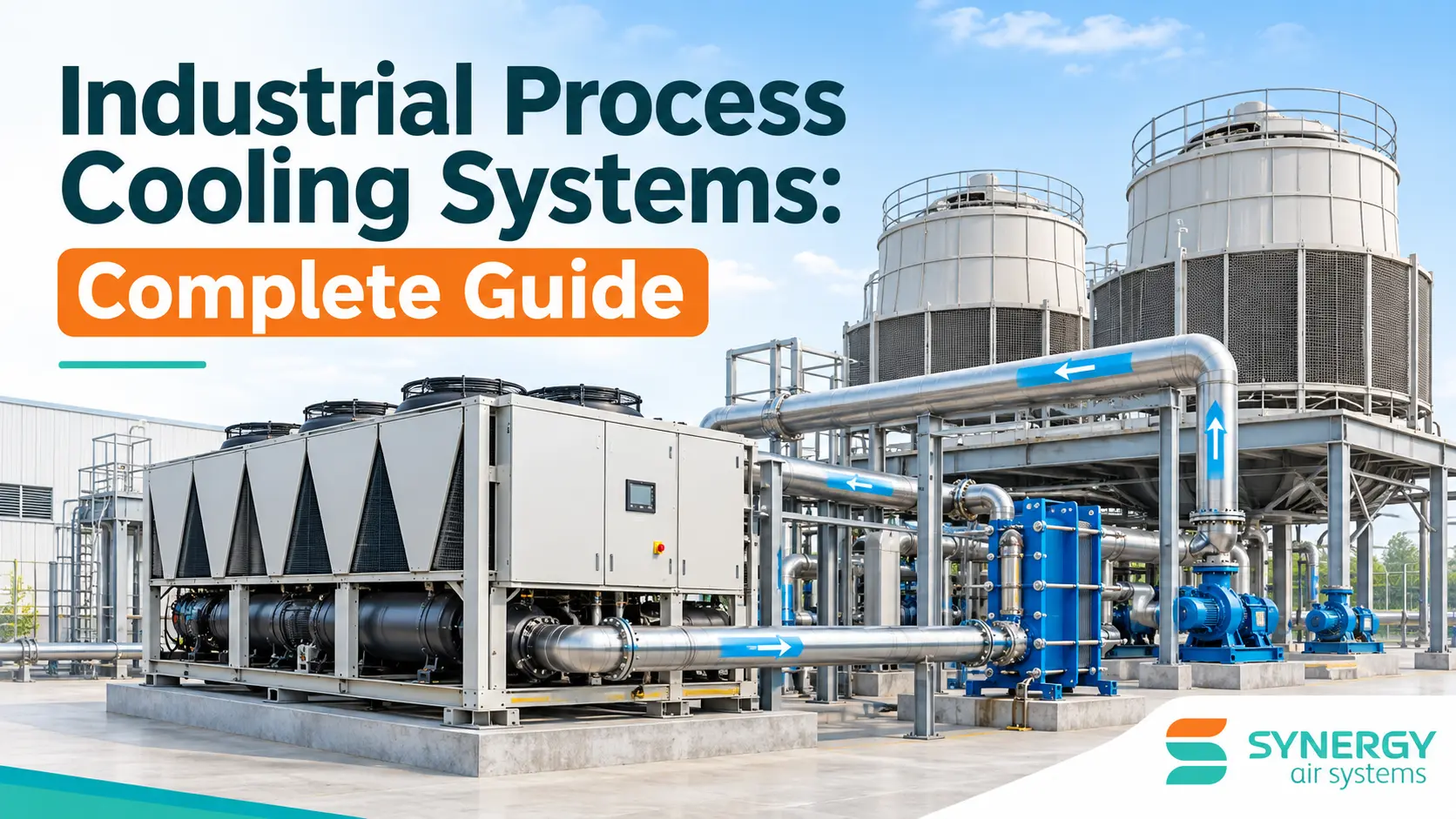
A Comprehensive Guide to Industrial Process Cooling Systems

Table of Contents
ToggleIndustrial process cooling systems are essential for maintaining controlled temperatures in manufacturing plants, processing facilities, and other industrial operations. They remove excess heat generated by machinery, production equipment, and industrial processes to maintain stable operating conditions, protect equipment, and support product quality.
Depending on the application, an industrial process cooling system may use water-cooled chillers, air-cooled chillers, cooling towers, heat exchangers, pumps, and chilled water distribution networks. Selecting the right system requires understanding the process heat load, required operating temperature, cooling capacity, water availability, and overall plant requirements.
This guide explains how industrial process cooling systems work, their main types and components, industrial applications, benefits, and the factors to consider when designing, selecting, installing, and maintaining a cooling solution.
What Are Industrial Process Cooling Systems?
Industrial process cooling systems are engineered systems designed to remove unwanted heat from industrial processes and maintain the required operating temperature of equipment, materials, and production environments.
Industrial operations generate heat through mechanical processes, chemical reactions, electrical equipment, manufacturing machinery, and other production activities. If this heat is not managed properly, it can affect production efficiency, equipment reliability, and product consistency.
Process cooling systems transfer heat away from the application using a cooling medium, commonly water or a water-based solution. The absorbed heat is then rejected to the surrounding environment through a chiller, cooling tower, condenser, or another heat rejection arrangement.
Understanding Industrial Process Cooling
Industrial process cooling involves controlling the temperature of a specific production process rather than simply cooling the air inside a building.
For example, a manufacturing plant may require chilled water to cool injection moulding machines, chemical processing equipment, hydraulic systems, or industrial machinery. The cooling system circulates water through the process equipment, absorbs heat, and returns the warmed water for cooling.
The system is designed according to the process temperature requirements, heat generation rate, operating schedule, and required cooling capacity.
Difference Between Process Cooling and Comfort Cooling
Although both systems remove heat, industrial process cooling and comfort cooling serve different purposes.
| Parameter | Process Cooling | Comfort Cooling |
|---|---|---|
| Main purpose | Maintain industrial process temperatures | Maintain indoor occupant comfort |
| Cooling requirement | Based on process heat load | Based on building heat load |
| Temperature control | Depends on equipment and production requirements | Based on indoor comfort conditions |
| Operating schedule | Often continuous or production-dependent | Usually follows occupancy schedules |
| Applications | Manufacturing, chemical plants, pharmaceuticals | Offices, commercial buildings, residential spaces |
Process cooling systems are generally designed around the thermal requirements of production equipment, while comfort cooling systems focus on indoor air temperature and occupant comfort.
Why Temperature Control Is Important in Industrial Operations
Maintaining the correct process temperature is important for several reasons:
- Production consistency: Stable temperatures help maintain consistent manufacturing conditions.
- Equipment protection: Removing excess heat helps prevent overheating and thermal stress.
- Product quality: Temperature-sensitive materials and processes require controlled operating conditions.
- Operational reliability: Proper cooling supports dependable equipment operation.
- Process safety: Some industrial applications require specific temperature limits to maintain safe operating conditions.
The required temperature range varies depending on the industrial process and equipment being cooled.
How Do Industrial Process Cooling Systems Work?
An industrial process cooling system works by absorbing heat from a production process and transferring it to another medium before rejecting it to the environment.
In a typical chilled water system, chilled water circulates through industrial equipment or heat exchangers. As it absorbs heat, its temperature increases. The warmer water then returns to the chiller, where the refrigeration cycle removes the absorbed heat and cools the water again.
This cycle continues as long as the process requires cooling.
The Basic Working Principle of Process Cooling
Most industrial chiller-based cooling systems operate through a refrigeration cycle involving four main components:
- Evaporator: Absorbs heat from the process water or cooling medium.
- Compressor: Increases the pressure and temperature of the refrigerant vapour.
- Condenser: Transfers heat from the refrigerant to air or water.
- Expansion valve: Reduces refrigerant pressure before it returns to the evaporator.
The refrigeration cycle allows the chiller to remove heat from the process water and maintain the required chilled water supply temperature.
How Heat Is Transferred and Removed
Heat transfer is the central principle of industrial process cooling.
Heat moves from a higher-temperature medium to a lower-temperature medium. In industrial applications, this transfer commonly takes place through heat exchangers, cooling coils, evaporators, or equipment jackets.
For example, hot process water can pass through one side of a heat exchanger while chilled water flows through the other side. Heat transfers between the two fluids without necessarily allowing them to mix.
The cooled process fluid can then return to the equipment, while the warmed cooling water travels back to the cooling system.
The Role of Chilled Water Circulation
Chilled water circulation is an important part of many industrial cooling systems.
A pump moves chilled water from the chiller through the distribution network to the equipment requiring cooling. After absorbing heat, the warmer return water flows back to the chiller.
A typical chilled water circulation system includes:
- Chiller supply and return connections
- Chilled water pumps
- Distribution headers
- Isolation and control valves
- Heat exchangers or cooling coils
- Temperature and pressure sensors
- Expansion and water treatment arrangements, where required
Proper hydraulic design is necessary to maintain the required flow rate and temperature difference across the cooling equipment.
How Heat Is Rejected Through Cooling Towers and Condensers
After heat is absorbed from the process, it must be rejected to the surrounding environment.
In water-cooled chiller systems, the condenser transfers heat to condenser water. This heated water is then circulated to a cooling tower, where heat is rejected mainly through evaporation and contact with ambient air.
In air-cooled chiller systems, the condenser uses fans to move ambient air across the condenser coils, allowing heat to be released directly into the atmosphere.
The appropriate heat rejection arrangement depends on the required cooling capacity, site conditions, available utilities, and operating requirements.
What Are the Main Types of Industrial Process Cooling Systems?
Industrial process cooling systems are available in different configurations. The right choice depends on process temperature requirements, cooling load, plant layout, operating conditions, and available resources.
Water-Cooled Chiller Systems
Water-cooled chillers use water to remove heat from the refrigerant in the condenser. The heated condenser water is generally circulated to a cooling tower, where the heat is rejected.
A typical water-cooled chiller installation includes:
- Water-cooled chiller
- Cooling tower
- Chilled water pumps
- Condenser water pumps
- Piping and distribution network
- Water treatment equipment
- Control and monitoring systems
Water-cooled chillers are commonly used in large industrial facilities where substantial and continuous cooling loads need to be managed.
Their overall performance depends on condenser water temperature, cooling tower conditions, heat exchanger cleanliness, and proper system operation.
Air-Cooled Chiller Systems
Air-cooled chillers reject heat directly into the atmosphere using fans and air-cooled condenser coils.
Unlike water-cooled systems, they generally do not require a separate cooling tower or condenser water circulation loop.
Common advantages include:
- Simpler cooling system arrangement
- No cooling tower requirement
- Reduced dependence on condenser water
- Relatively straightforward installation
- Suitable for facilities with limited water availability
However, air-cooled chiller performance can be affected by high ambient temperatures. Equipment selection should consider the local climate and required operating conditions.
Cooling Tower Systems
Cooling towers are heat rejection devices used to remove heat from circulating water.
Warm water enters the cooling tower and comes into contact with moving air. A portion of the water evaporates, removing heat from the remaining water. The cooled water is collected in the tower basin and circulated back to the condenser or industrial process, depending on the system arrangement.
Cooling towers are commonly used in:
- Industrial chiller installations
- Power plants
- Chemical processing facilities
- Manufacturing plants
- Large industrial cooling networks
Cooling tower selection depends on heat rejection capacity, water flow rate, wet-bulb temperature, approach temperature, and site conditions.
Closed-Loop Cooling Systems
A closed-loop cooling system circulates the cooling fluid through a sealed piping network.
The process fluid remains within the circuit and transfers heat through a heat exchanger or another cooling device. This arrangement helps limit direct exposure of the circulating fluid to the surrounding environment.
Potential advantages include:
- Reduced contamination from external sources
- Better control over circulating fluid quality
- Lower evaporation losses within the process loop
- Reduced scaling and fouling risks when properly designed and maintained
Closed-loop systems are often used where process fluid cleanliness and controlled operating conditions are important.
Open-Loop Cooling Systems
An open-loop cooling system allows the circulating water to come into direct contact with the environment or the process being cooled.
Cooling towers are a common example of an open heat rejection arrangement. Water is exposed to air, and some of it evaporates during the cooling process.
Open-loop systems can provide effective heat rejection, but they require appropriate water treatment and maintenance to manage scaling, corrosion, biological growth, and water losses.
Direct and Indirect Process Cooling Systems
Industrial process cooling can also be classified according to how the cooling medium interacts with the process.
Direct cooling: The cooling medium comes into direct contact with the material or process being cooled. This method is used where the application allows direct contact and the cooling medium does not compromise product quality or process requirements.
Indirect cooling: Heat is transferred through a heat exchanger, cooling jacket, or coil without direct mixing of the process fluid and cooling medium.
Indirect cooling is commonly preferred when process fluid contamination must be avoided or when the two fluid circuits require separate operating conditions.
Read Also: Industrial HVAC Systems Ahmedabad: Complete Guide for Manufacturing Plants
What Are the Key Components of an Industrial Process Cooling System?
An industrial process cooling system consists of several interconnected components. Each component performs a specific function in heat absorption, heat transfer, circulation, or heat rejection.
Industrial Chillers
An industrial chiller is the main cooling equipment in many process cooling installations.
It removes heat from circulating water or another cooling fluid and maintains the required supply temperature. Depending on the application, chillers may be air-cooled or water-cooled.
Chiller selection depends on cooling capacity, required leaving water temperature, operating conditions, energy consumption, and the type of process being cooled.
Compressors, Evaporators and Condensers
These components form the main parts of a vapour-compression refrigeration system.
- Compressor: Circulates refrigerant and raises its pressure.
- Evaporator: Transfers heat from the process cooling fluid to the refrigerant.
- Condenser: Releases the absorbed heat to air or water.
- Expansion valve: Controls refrigerant flow and reduces its pressure before the evaporator.
Their coordinated operation enables the chiller to continuously remove heat from the process.
Heat Exchangers
Heat exchangers transfer thermal energy between two fluids at different temperatures.
They are widely used in industrial cooling applications where the process fluid and cooling water must remain separate.
Common types include:
- Shell-and-tube heat exchangers
- Plate heat exchangers
- Plate-and-frame heat exchangers
- Double-pipe heat exchangers
The selection depends on operating pressure, temperature, fluid characteristics, heat transfer requirements, available space, and maintenance considerations.
Cooling Towers
Cooling towers reject heat from condenser water or other circulating water streams.
Their main components may include:
- Cooling tower fan
- Fill material
- Water distribution system
- Drift eliminators
- Collection basin
- Water circulation connections
Regular maintenance is necessary to manage water quality, scaling, corrosion, and biological growth.
Hot Well and Cold Well Pumping Stations
Hot well and cold well pumping stations can form part of an industrial cooling water arrangement.
A hot well generally collects warmer return water before it is pumped towards the cooling equipment. After cooling, the water is collected in a cold well or basin and supplied to the required process or cooling circuit.
The exact arrangement depends on the plant’s hydraulic design and cooling system configuration.
These pumping stations help manage water collection, circulation, and distribution across the cooling network.
Chilled Water Pumps and Piping Networks
Pumps provide the required water flow through the cooling system.
The piping network connects chillers, heat exchangers, process equipment, and other cooling components. Proper pipe sizing and hydraulic design help maintain the required flow rate and pressure throughout the system.
Pump selection should consider:
- Required water flow rate
- Total dynamic head
- System pressure drop
- Fluid temperature and properties
- Operating schedule
- Pump efficiency
Control Panels, Sensors and Temperature Monitoring
Control and monitoring systems help maintain stable cooling conditions.
Common monitoring devices include temperature sensors, pressure transmitters, flow meters, level sensors, and control valves.
These instruments allow operators to monitor system conditions, identify abnormal operating parameters, and control equipment operation according to process requirements.
What Industries Use Process Cooling Systems?
Industrial process cooling is used across many sectors where heat must be removed to maintain production conditions and equipment performance.
Chemical and Petrochemical Industries
Chemical manufacturing processes can generate significant heat through reactions, mixing, distillation, and other operations.
Process cooling systems help maintain required temperatures in reactors, condensers, storage systems, and production equipment.
Pharmaceutical and Healthcare Manufacturing
Pharmaceutical manufacturing often involves temperature-sensitive processes and equipment.
Industrial cooling systems may support:
- Manufacturing equipment cooling
- Process water temperature control
- Production machinery cooling
- Utility systems
- Temperature-sensitive processing operations
Cooling system design must account for the specific process requirements and applicable facility standards.
Read Also: Pharmaceutical HVAC System Gujarat: Designing for GMP, WHO & Schedule M
Food and Beverage Processing
Food and beverage production involves several temperature-dependent operations.
Process cooling systems may be used for product cooling, mixing, fermentation, refrigeration support, and equipment temperature control.
Maintaining suitable temperatures helps support product consistency and process requirements.
Read Also: HVAC for Food Industry Gujarat: Hygiene, Humidity & Contamination Control
Plastics and Polymer Manufacturing
Plastic processing equipment generates heat during moulding, extrusion, and other manufacturing operations.
Cooling systems remove this heat from moulds, hydraulic systems, extruders, and associated machinery.
Consistent cooling is important for controlling production cycle times, material behaviour, and product quality.
Metalworking and Automotive Industries
Metalworking and automotive manufacturing processes involve heat generated by machining, welding, metal forming, and other operations.
Industrial cooling systems may support machine tools, hydraulic equipment, cutting processes, and production machinery.
Power Generation and Heavy Manufacturing
Power generation and heavy industrial facilities require cooling for equipment such as generators, compressors, turbines, and auxiliary systems.
The cooling arrangement depends on the equipment design, heat load, operating conditions, and plant utilities.
What Are the Benefits of Industrial Process Cooling Systems?
A properly designed industrial process cooling system offers several operational benefits.
Maintaining Consistent Process Temperatures
Temperature stability is important for processes that operate within defined thermal limits. An appropriately designed cooling system helps maintain the required operating temperature despite changes in production load.
Improving Production Efficiency
Excessive heat can affect machinery performance and production processes. Effective cooling helps maintain suitable operating conditions and can reduce heat-related interruptions.
Protecting Industrial Equipment
Overheating can contribute to equipment wear, component damage, and reduced service life. Process cooling helps remove excess heat and supports reliable equipment operation.
Supporting Product Quality
Some manufacturing processes are sensitive to temperature fluctuations. Maintaining controlled cooling conditions helps reduce unwanted variations in production.
Improving Energy and Operational Efficiency
Energy efficiency depends on the complete system design and operating strategy. Proper chiller selection, pump sizing, cooling tower performance, heat exchanger maintenance, and control optimisation can help reduce unnecessary energy consumption.
How to Select the Right Industrial Process Cooling System?
Selecting an industrial process cooling system requires a detailed understanding of the application and operating conditions. Choosing equipment based only on nominal cooling capacity may lead to poor performance or unnecessary operating costs.
Determine the Required Cooling Capacity
Cooling capacity represents the amount of heat a system can remove over a given period.
It is commonly expressed in kilowatts (kW), refrigeration tons (TR), or other suitable units.
The required capacity should be calculated based on the heat generated by the process, the operating schedule, and the required temperature conditions.
Calculate the Process Heat Load
Heat load calculation is one of the most important stages of cooling system design.
The calculation may consider:
- Heat generated by production machinery
- Heat released during chemical or manufacturing processes
- Heat entering through the surrounding environment
- Fluid flow rate and temperature difference
- Operating hours and production variations
- Simultaneous operation of multiple equipment items
An accurate heat load calculation helps determine the appropriate chiller and supporting equipment capacity.
Evaluate Operating Temperature Requirements
Different processes require different cooling temperatures.
The design should consider the required supply temperature, return temperature, permissible temperature variation, and minimum operating temperature.
The cooling system must be capable of maintaining these conditions under expected operating loads.
Choose Between Air-Cooled and Water-Cooled Systems
Air-cooled and water-cooled chillers have different installation and operating requirements.
Air-cooled chillers may be suitable where water availability is limited or a simpler heat rejection arrangement is preferred.
Water-cooled chillers may be appropriate for larger installations where a cooling tower and condenser water system can be accommodated.
The final choice should consider cooling demand, climate, water availability, installation space, energy use, and maintenance requirements.
Consider Water Availability and Quality
Water quality affects the performance and reliability of industrial cooling systems.
Untreated water can cause scaling, corrosion, fouling, and biological growth. These problems can reduce heat transfer efficiency and increase maintenance requirements.
Water treatment should be selected according to the system configuration, water chemistry, and operating conditions.
Assess Energy Consumption and Maintenance Requirements
The initial equipment cost is only one part of the overall investment.
A complete evaluation should consider electricity consumption, pump and fan operation, water treatment, routine maintenance, spare parts, and expected equipment service life.
A well-engineered system should balance cooling performance, reliability, and long-term operating costs.
What Factors Affect Industrial Cooling System Performance?
The performance of an industrial cooling system depends on several design and operating parameters.
Cooling Load and Operating Conditions
Changes in production rates and equipment operation can increase or decrease the cooling demand.
A system should be designed to handle the expected operating load and reasonable variations in production requirements.
Water Flow Rate and Temperature Difference
Water flow rate and the temperature difference between supply and return water affect heat transfer.
For a water-based cooling circuit, the approximate heat transfer rate can be calculated using:
Q = m × Cp × ΔT
Where:
- Q = Heat transfer rate
- m = Mass flow rate of water
- Cp = Specific heat capacity of water
- ΔT = Temperature difference between return and supply water
This relationship helps engineers estimate cooling requirements and evaluate water circulation conditions.
Heat Exchanger Efficiency
Heat exchanger performance depends on the heat transfer surface, fluid flow conditions, temperature difference, cleanliness, and equipment design.
Scaling and fouling can reduce heat transfer and increase pressure drop, making regular inspection important.
Ambient Temperature and Humidity
Ambient conditions influence the performance of heat rejection equipment.
For example, high outdoor air temperatures can reduce the heat rejection capability of air-cooled chillers. Cooling tower performance is influenced by the outdoor wet-bulb temperature and the cooling tower’s approach temperature.
Scaling, Fouling and Water Quality
Mineral deposits, suspended solids, corrosion products, and biological growth can accumulate within cooling equipment and piping.
These issues may restrict water flow and reduce heat transfer.
Appropriate water treatment, filtration, inspection, and cleaning help maintain system performance.
System Design and Regular Maintenance
Poor pipe sizing, incorrect pump selection, inadequate flow distribution, and unsuitable control settings can affect cooling performance.
Proper engineering design and preventive maintenance help ensure that the system operates according to its intended requirements.
Industrial Process Cooling System Installation and Maintenance
Successful industrial cooling projects require more than selecting a chiller. The complete system must be engineered, installed, commissioned, and maintained according to the application’s requirements.
System Planning and Engineering Design
The design process begins with understanding the industrial process and its cooling demand.
Important design activities include:
- Process heat load assessment
- Cooling capacity calculation
- Chiller and cooling tower selection
- Pump and piping design
- Heat exchanger selection
- Equipment layout and space planning
- Electrical and control system design
- Water treatment requirements
A coordinated design helps ensure that all components work together as an integrated cooling system.
Equipment Installation and Commissioning
Installation involves positioning the equipment, connecting piping and electrical systems, and integrating the cooling equipment with the process.
Commissioning verifies that the system operates as intended.
Typical checks include water flow, pump operation, pressure, supply and return temperatures, chiller performance, control settings, and safety devices.
Preventive Maintenance Practices
Regular maintenance helps identify potential problems before they affect production.
Important maintenance activities include:
- Inspecting chillers and refrigeration components
- Checking pumps, motors, and mechanical seals
- Cleaning heat exchangers and cooling tower components
- Monitoring water quality
- Inspecting piping, valves, and connections
- Checking sensors and control panels
- Reviewing operating temperatures and pressures
Maintenance frequency should follow equipment manufacturer recommendations and actual operating conditions.
Monitoring Cooling System Performance
Continuous monitoring helps operators understand how efficiently the system is working.
Useful operating parameters include:
- Chilled water supply and return temperatures
- Condenser water temperatures
- Water flow rates
- Pump discharge pressure
- Chiller power consumption
- Cooling tower approach temperature
- Equipment operating hours
Monitoring these parameters can help identify changes in system performance and support timely maintenance.
Common Industrial Cooling System Problems
Some common issues include:
Insufficient cooling: May result from inadequate cooling capacity, low water flow, refrigerant problems, or excessive process heat load.
High energy consumption: Can be associated with poor equipment efficiency, incorrect control settings, fouled heat exchangers, or unsuitable operating conditions.
Water leakage: May occur due to damaged piping, loose connections, worn seals, or corrosion.
Scaling and fouling: Can reduce heat transfer and restrict water flow.
Pump performance problems: May be caused by incorrect pump selection, air in the system, blockage, or mechanical wear.
Identifying the underlying cause is important before implementing corrective action.
Frequently Asked Questions
What is the purpose of an industrial process cooling system?
An industrial process cooling system removes excess heat from manufacturing processes, machinery, and industrial equipment. It maintains the required operating temperature, supports product quality, and helps protect equipment from overheating.
What is the difference between an industrial chiller and a cooling tower?
An industrial chiller uses a refrigeration cycle to remove heat from water or another cooling fluid. A cooling tower rejects heat from circulating water into the atmosphere, mainly through evaporation.
In a typical water-cooled chiller installation, the chiller and cooling tower work together to provide process cooling and heat rejection.
Which is better, an air-cooled or water-cooled chiller?
Neither option is universally better. Air-cooled chillers generally have a simpler installation and do not require a cooling tower. Water-cooled chillers use a separate condenser water circuit and cooling tower.
The right option depends on cooling capacity, ambient conditions, water availability, energy consumption, installation space, and maintenance requirements.
How do I calculate the cooling capacity required for an industrial process?
Cooling capacity is determined by calculating the heat generated by the process and the amount of heat that must be removed to maintain the required temperature.
The calculation may include equipment heat loads, fluid flow rates, temperature differences, operating schedules, and production variations. A qualified cooling system engineer should evaluate these parameters before equipment selection.
What is a closed-loop industrial cooling system?
A closed-loop industrial cooling system circulates cooling fluid through a sealed circuit. Heat is transferred from the process to another cooling medium through a heat exchanger or cooling device.
This arrangement helps maintain control over the circulating fluid and can reduce contamination from external sources.
How often should an industrial process cooling system be maintained?
Maintenance frequency depends on equipment type, operating hours, water quality, environmental conditions, and manufacturer recommendations.
Regular inspections, water quality checks, heat exchanger cleaning, pump maintenance, and performance monitoring are important for reliable operation.
Can one cooling system serve multiple industrial processes?
Yes. A centralised industrial cooling system can supply chilled water to multiple production areas or equipment items.
However, the system must be designed to handle the combined cooling load, required flow rates, temperature differences, and varying operating schedules. Separate cooling circuits or control arrangements may be necessary when processes have different temperature requirements.
Conclusion
Industrial process cooling systems play an important role in maintaining production temperatures, protecting equipment, and supporting reliable industrial operations. From air-cooled and water-cooled chillers to cooling towers, heat exchangers, and chilled water pumping networks, each component contributes to the overall cooling process.
Selecting the right solution requires accurate heat load calculations, suitable equipment selection, proper hydraulic design, and an understanding of the plant’s operating conditions. Regular maintenance and performance monitoring are equally important for maintaining cooling efficiency and system reliability.
Synergy Air Systems provides industrial and commercial HVAC engineering solutions, including industrial chiller installations, process cooling systems, cooling towers, and associated pumping and water circulation arrangements. With appropriate system planning, engineering, installation, and commissioning, industrial facilities can establish cooling infrastructure suited to their process requirements.
Table of Contents
Toggle