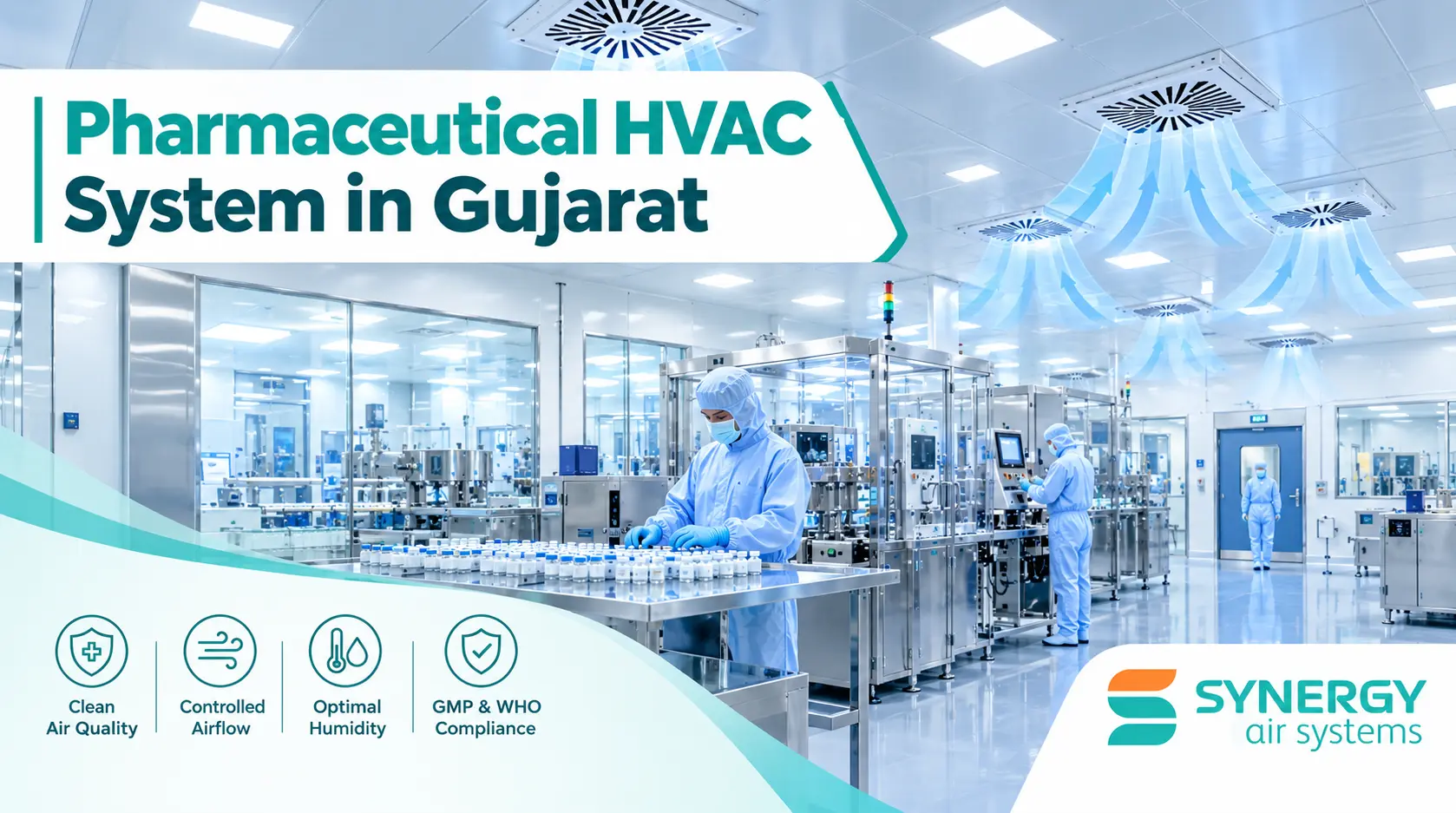
Pharmaceutical HVAC System Gujarat: Designing for GMP, WHO & Schedule M

Table of Contents
ToggleA pharmaceutical HVAC system in Gujarat must do more than provide a comfortable temperature. In pharmaceutical manufacturing and healthcare environments, HVAC directly supports contamination control, cleanroom conditions, pressure relationships, temperature and humidity control, and validated production processes.
For pharmaceutical companies, facility managers, MEP consultants, and engineering contractors, HVAC design should therefore begin with the process and regulatory requirements, not simply the cooling load.
This guide explains how Pharmaceutical HVAC systems are designed around GMP, WHO GMP, Schedule M, ISO 14644, HVAC qualification, HEPA filtration, AHUs, differential pressure, temperature control, humidity control, and contamination control.
What Is a Pharmaceutical HVAC System?
A pharmaceutical HVAC system is an engineered heating, ventilation, air-conditioning and air-distribution system designed to maintain controlled environmental conditions in areas where medicines, active ingredients, packaging materials, or other regulated products are manufactured, tested, stored, or handled.
Unlike conventional commercial HVAC, Pharmaceutical HVAC must consider:
- Cleanroom classification
- Air cleanliness
- Temperature and humidity
- Air changes and airflow patterns
- Differential pressure
- HEPA filtration
- Cross-contamination prevention
- Fresh-air requirements
- Return and exhaust-air arrangements
- Equipment and room zoning
- Cleaning and maintenance
- Qualification and validation requirements
The exact design depends on the pharmaceutical process, room classification, product risk, building layout, equipment, occupancy, and applicable regulatory requirements.
For a pharmaceutical facility in Gujarat, the HVAC design should be developed as part of the overall facility engineering strategy rather than treated as a standalone air-conditioning installation.
Why Pharmaceutical HVAC Design Is Different from Conventional HVAC
A standard office HVAC system generally focuses on occupant comfort. Pharmaceutical HVAC has a broader engineering responsibility.
For example, consider a production area handling a temperature-sensitive pharmaceutical product. Maintaining a nominal room temperature may not be enough. The facility may also need controlled humidity, filtered air, a defined pressure relationship with adjacent rooms, appropriate airflow distribution, and documented qualification.
Similarly, a cleanroom may require airflow and filtration arrangements that support the required cleanliness level.
This makes pharmaceutical HVAC a combination of:
Cooling + ventilation + filtration + airflow management + pressure control + environmental control + qualification.
How GMP Influences Pharmaceutical HVAC Design
Good Manufacturing Practice, or GMP, establishes principles intended to ensure pharmaceutical products are consistently manufactured and controlled according to appropriate quality requirements.
HVAC supports GMP objectives by helping control the environmental conditions surrounding pharmaceutical processes.
1. Contamination Control
Air can carry particles and microorganisms between areas. HVAC zoning and airflow design therefore become important parts of contamination-control strategy.
The system may need to separate areas based on:
- Product risk
- Process stage
- Personnel movement
- Material movement
- Cleanliness requirements
- Pressure relationships
The objective is not simply to move air. It is to control where air comes from, where it goes, and what happens to it along the way.
2. Cross-Contamination Prevention
Where different products or materials are processed, uncontrolled air movement can create contamination risks.
HVAC design can address these risks through appropriate:
- Room pressure relationships
- Airflow direction
- Air-handling arrangements
- Filtration
- Airlocks
- Pressure monitoring
- Zoning
The correct arrangement depends on the manufacturing process and facility design.
3. Environmental Control
Pharmaceutical processes can have specific environmental requirements.
The HVAC system may therefore be designed to maintain controlled:
- Temperature
- Relative humidity
- Air cleanliness
- Pressure differential
- Ventilation
- Airflow patterns
The required operating range should come from the process and approved facility requirements rather than from an arbitrary HVAC specification.
What Does WHO GMP Mean for Pharmaceutical HVAC?
WHO GMP provides internationally recognized principles for pharmaceutical manufacturing and quality assurance.
HVAC is relevant because environmental conditions can influence product quality and manufacturing consistency.
A WHO GMP-oriented HVAC design should therefore consider the relationship between:
Room → Process → Airflow → Filtration → Pressure → Monitoring → Qualification
For example, if a room needs a controlled pressure relationship with an adjacent area, the HVAC system needs sufficient control and monitoring to maintain that relationship under defined operating conditions.
Likewise, filtration requirements should be selected according to the required cleanliness and process risk not simply because a particular filter type is commonly used.
How Schedule M Affects Pharmaceutical HVAC in India
For pharmaceutical facilities in India, Schedule M is an important regulatory reference concerning Good Manufacturing Practices and requirements for premises and related systems.
Its relevance to HVAC includes the need to consider appropriate environmental conditions, contamination control, air handling, and facility design according to the nature of pharmaceutical operations.
However, HVAC design should not be reduced to a checklist of individual requirements.
A compliant facility needs an integrated engineering approach that connects:
- GMP requirements
- Process requirements
- Room classifications
- HVAC zoning
- Airflow design
- Filtration
- Pressure control
- Monitoring
- Qualification documentation
The final design should always be reviewed against the current applicable regulatory requirements and the specific pharmaceutical process.
What Is the Role of the AHU in Pharmaceutical HVAC?
The Air Handling Unit (AHU) is one of the central components of a Pharmaceutical HVAC system.
Depending on the application, an AHU may incorporate components such as:
- Fresh-air section
- Mixing arrangement where appropriate
- Pre-filtration
- Fine filtration
- Cooling coil
- Heating arrangement where required
- Humidification or dehumidification provisions
- Fan section
- Final filtration
- Dampers
- Access and maintenance sections
- Controls and instrumentation
The actual configuration should be selected according to the required air quality, process, room classification, energy requirements, and facility layout.
Why AHU Selection Matters
An AHU should not be selected only on nominal airflow and cooling capacity.
Engineers should also consider:
- Required airflow volume
- External static pressure
- Filtration stages
- Coil performance
- Fan selection
- Air leakage
- Access for maintenance
- Cleanability
- Material construction
- Control strategy
- Redundancy requirements, where applicable
An appropriately engineered AHU can make downstream commissioning, maintenance, and qualification more manageable.
HEPA Filters in Pharmaceutical HVAC Systems
A HEPA filter is commonly used where high-efficiency particulate filtration is required.
In pharmaceutical cleanroom applications, HEPA filtration can be integrated into air-handling or terminal air-distribution arrangements depending on the room design.
However, simply installing HEPA filters does not automatically establish a compliant cleanroom.
The complete system must also consider:
- Filter installation
- Filter integrity
- Air distribution
- Room leakage
- Pressure relationships
- Airflow patterns
- Cleaning procedures
- Monitoring
- Qualification testing
This distinction is important because cleanroom performance is a system-level outcome.
Differential Pressure and Pharmaceutical HVAC
Differential pressure is one of the most important controls used in pharmaceutical HVAC.
A pressure difference between adjacent rooms can help influence the direction in which air moves when doors or other openings are present.
For example, a cleaner area may be maintained at a pressure relationship intended to reduce infiltration from a less clean adjacent area.
However, the pressure cascade should be designed according to the facility’s contamination-control strategy.
What Can Affect Differential Pressure?
Pressure relationships can change because of:
- Door opening
- Leakage
- Filter loading
- Fan performance
- Damper position
- Changes in airflow
- Exhaust operation
- Room occupancy
- Equipment operation
Therefore, differential pressure should not be treated as a one-time commissioning measurement. Where required, it needs appropriate monitoring and control during operation.
Temperature and Humidity Control
Temperature control is important for both personnel and pharmaceutical processes.
Humidity control can be equally important.
Excessive humidity may contribute to problems such as:
- Product or material sensitivity
- Condensation
- Microbial-control challenges
- Packaging-related issues
- Process inconsistency
Low humidity can also create process and material concerns in certain applications.
A pharmaceutical HVAC system in Gujarat may face additional seasonal challenges because outdoor conditions can vary significantly throughout the year.
Therefore, HVAC design should account for local climatic conditions while establishing indoor operating conditions based on the process and facility requirements.
Cleanroom HVAC Design and ISO 14644
ISO 14644 provides an important framework for cleanroom and associated controlled-environment considerations.
Cleanroom design involves much more than selecting an air conditioner.
Engineers need to consider:
- Room classification
- Air cleanliness
- Airflow distribution
- HEPA filtration
- Pressure differentials
- Recovery characteristics
- Temperature and humidity
- Personnel and material flows
- Room finishes
- Door arrangements
- Equipment placement
Airflow Patterns Matter
Airflow should be evaluated in relation to room geometry and contamination sources.
A poorly positioned supply outlet or return-air grille can create undesirable airflow patterns even when the total airflow appears adequate.
For critical environments, airflow visualization studies may therefore form part of qualification activities.
What Is HVAC Qualification?
HVAC qualification provides documented evidence that the installed HVAC system performs according to predetermined requirements.
Qualification may involve different stages and tests depending on the project and validation strategy.
These can include activities associated with:
- Design Qualification (DQ)
- Installation Qualification (IQ)
- Operational Qualification (OQ)
- Performance Qualification (PQ)
The precise qualification protocol should be established according to the facility’s validation plan and applicable requirements.
Typical HVAC Qualification Checks
Depending on the facility, qualification and commissioning activities may evaluate:
| Parameter | Purpose |
|---|---|
| Airflow volume | Confirms designed air delivery |
| Air velocity | Supports airflow assessment where applicable |
| Differential pressure | Verifies room pressure relationships |
| Temperature | Confirms environmental control |
| Relative humidity | Confirms humidity control |
| HEPA integrity | Checks filter installation integrity |
| Air cleanliness | Assesses cleanroom performance |
| Airflow visualization | Evaluates airflow direction/patterns |
| Recovery | Assesses return to specified cleanliness conditions |
| Alarm functions | Verifies monitoring and control responses |
Not every project requires every test in the same manner. The qualification program should reflect the facility’s design, risk assessment, regulatory requirements, and intended operation.
Pharmaceutical HVAC Design Process: A Practical Approach
A technically sound project normally starts before HVAC equipment selection.
Step 1: Understand the Pharmaceutical Process
The engineer should understand:
- What is being manufactured?
- Which rooms are involved?
- What materials enter each area?
- What personnel movements occur?
- Which areas have higher contamination risks?
- Which processes generate heat, moisture, or particles?
This information influences the HVAC zoning strategy.
Step 2: Develop HVAC Zoning
The facility can then be divided into suitable HVAC zones based on:
- Cleanliness
- Pressure requirements
- Process compatibility
- Temperature and humidity
- Operating schedules
- Contamination risk
Step 3: Establish Room Requirements
Each room should have defined environmental requirements.
A room schedule may include:
- Room classification
- Temperature range
- Relative humidity
- Pressure relationship
- Airflow requirement
- Filtration
- Fresh-air requirement
- Exhaust requirement
Step 4: Select AHUs and Air Distribution
Once room requirements are established, engineers can determine the appropriate AHU configuration, airflow quantities, ductwork and terminal arrangements.
Step 5: Design Controls and Monitoring
Controls should support the required operating conditions.
Depending on the facility, this can include monitoring of:
- Temperature
- Relative humidity
- Differential pressure
- Filter condition
- Fan operation
- Alarms
Critical parameters may require appropriate recording and review procedures.
Step 6: Commission and Qualify
The completed system should be tested against predefined acceptance criteria.
Documentation is important because pharmaceutical HVAC performance must be demonstrable not merely assumed from equipment specifications.
Common Pharmaceutical HVAC Design Mistakes
Designing Only for Cooling Load
A pharmaceutical facility can have a correctly calculated cooling load and still have an unsuitable HVAC system.
Cooling capacity is only one part of the design.
Treating All Rooms the Same
Different rooms can have different cleanliness, pressure, temperature and humidity requirements.
A single generic HVAC strategy may therefore be inappropriate.
Ignoring Airflow Direction
Total airflow does not automatically guarantee appropriate airflow behavior.
Supply and return locations must be evaluated as part of the room design.
Selecting Filters Without Considering the Complete System
Filter selection should consider the overall air-cleanliness strategy, pressure drop, maintenance and qualification requirements.
Leaving Qualification Until the End
Qualification requirements should influence design from the beginning.
If test points, monitoring arrangements or access requirements are ignored during design, qualification can become unnecessarily difficult.
Choosing a Pharmaceutical HVAC Contractor in Gujarat
Pharmaceutical companies should evaluate HVAC contractors based on their engineering approach rather than equipment supply alone.
Useful questions include:
- Does the contractor understand pharmaceutical cleanroom HVAC?
- Can they develop HVAC zoning based on process requirements?
- Do they understand pressure cascades and contamination control?
- Can they design AHU and filtration arrangements appropriately?
- Do they consider temperature and humidity control?
- Can they support commissioning and HVAC qualification?
- Can they coordinate with MEP consultants and other contractors?
- Can they provide appropriate technical documentation?
- Do they understand the operating and maintenance requirements of pharmaceutical facilities?
For facility managers and engineering teams, this approach helps distinguish an HVAC installation from a properly engineered pharmaceutical environmental-control system.
Why Pharmaceutical HVAC Requires a System-Level Approach
The most important principle is simple:
A Pharmaceutical HVAC system should be designed around the pharmaceutical process, not around an air-conditioning machine.
GMP, WHO GMP, Schedule M and cleanroom requirements create a framework, but successful implementation depends on how those requirements are translated into actual engineering decisions.
AHUs, HEPA filters, ductwork, controls, pressure relationships, temperature control and humidity control must work together.
For pharmaceutical manufacturers in Gujarat, local climatic conditions, facility architecture and manufacturing requirements should also be incorporated into the design from the beginning.
FAQs About Pharmaceutical HVAC Systems
What is a Pharmaceutical HVAC system?
A Pharmaceutical HVAC system is an engineered HVAC installation designed to control environmental conditions such as temperature, humidity, air cleanliness, airflow and pressure in pharmaceutical facilities.
Why is HVAC important in pharmaceutical manufacturing?
HVAC helps support contamination control, controlled environmental conditions, appropriate airflow, pressure relationships and process requirements within pharmaceutical manufacturing areas.
Is HEPA filtration mandatory for every pharmaceutical room?
Not necessarily. HEPA filtration requirements depend on the room classification, process, contamination-control strategy and applicable requirements. The correct filtration arrangement should be established during engineering design.
What is the role of differential pressure in a cleanroom?
Differential pressure helps establish controlled airflow relationships between adjacent areas. The required pressure cascade depends on the facility’s contamination-control strategy and room classification.
What is HVAC qualification?
HVAC qualification is documented verification that an HVAC system performs according to predefined requirements and acceptance criteria. The scope depends on the facility and qualification strategy.
Does Gujarat’s climate affect pharmaceutical HVAC design?
Yes. Outdoor temperature and humidity conditions affect cooling, dehumidification and ventilation design. Pharmaceutical HVAC systems should use appropriate local design conditions together with the required indoor process conditions.
What should pharmaceutical companies consider when selecting an HVAC contractor?
They should consider pharmaceutical HVAC experience, cleanroom engineering capability, filtration and pressure-control expertise, documentation, commissioning support, qualification understanding and coordination with the wider project team.
Key Takeaways
- Pharmaceutical HVAC is more than conventional air conditioning.
- GMP, WHO GMP and Schedule M should be considered during facility and HVAC planning.
- Cleanroom performance depends on the complete HVAC and room system.
- AHUs, HEPA filtration, airflow distribution and pressure control must work together.
- Temperature and humidity should be designed around actual process requirements.
- ISO 14644 is an important reference for cleanroom-related design and classification.
- HVAC qualification should be considered from the design stage, not added as an afterthought.
- Gujarat’s climatic conditions should be incorporated into HVAC engineering.
- The right pharmaceutical HVAC contractor should provide engineering, commissioning and qualification support not just equipment installation.
For pharmaceutical manufacturers, laboratories and healthcare facilities planning a new cleanroom, facility expansion or HVAC upgrade, Synergy Air Systems can support the engineering and implementation of Pharmaceutical HVAC solutions based on the project’s process, environmental and facility requirements.
Table of Contents
Toggle