HVAC for Food Industry Gujarat: Hygiene, Humidity & Contamination Control

Table of Contents
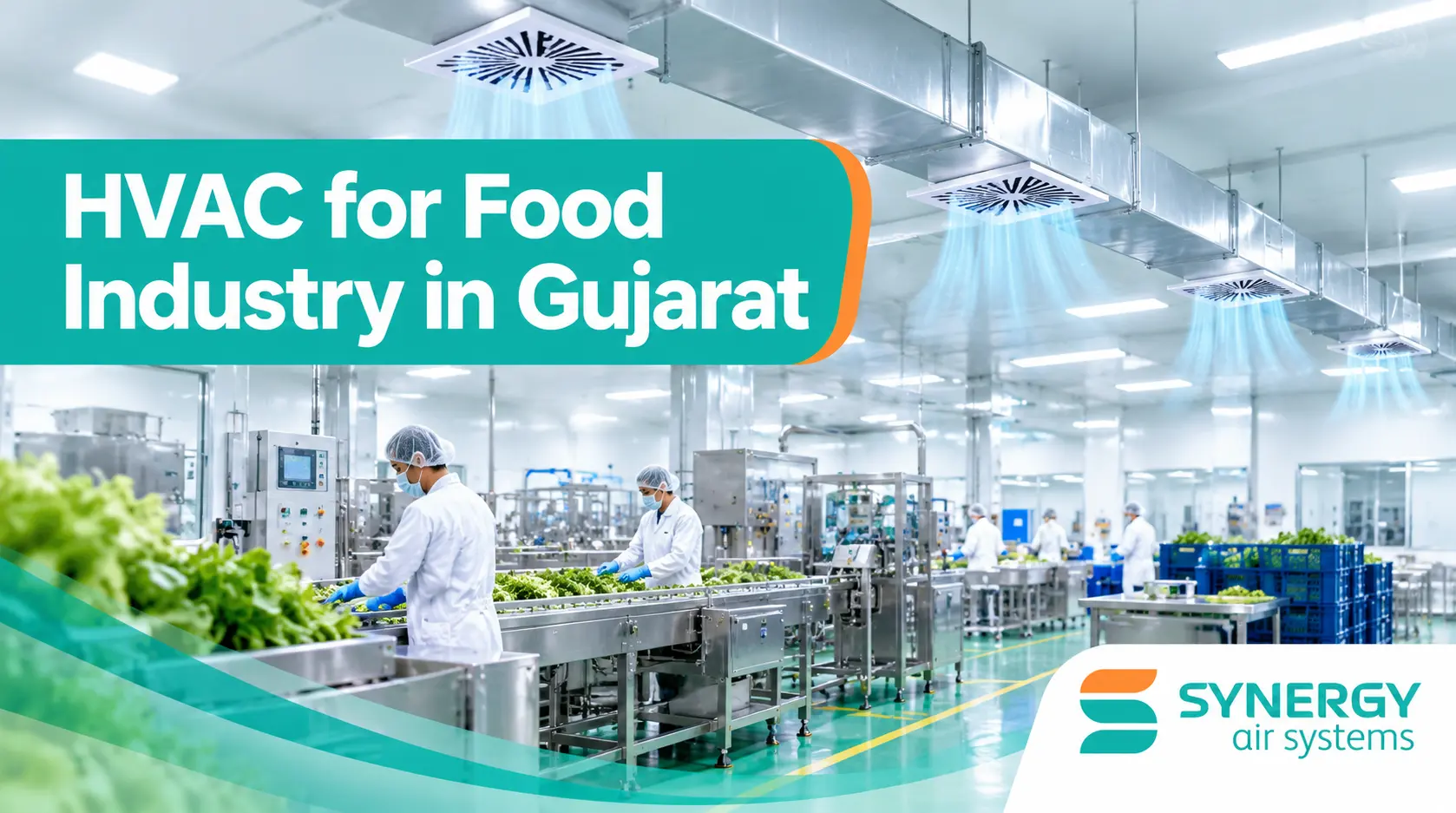
ToggleThe HVAC for food industry Gujarat plays a critical role in maintaining hygienic production conditions, controlling temperature and humidity, and reducing the risk of airborne contamination. In food processing facilities, HVAC is not simply about keeping workers comfortable it is part of the overall food safety and process-control strategy.
A properly designed Food Processing HVAC system helps maintain suitable environmental conditions across production rooms, packaging areas, storage spaces, laboratories, and other controlled zones. It can also support HACCP-based controls by helping manage environmental hazards such as excessive moisture, condensation, uncontrolled airflow, and cross contamination.
For food manufacturers in Gujarat, where seasonal heat and humidity can create additional challenges, HVAC design needs to consider the product, process, building, airflow pattern, occupancy, equipment heat load, and hygiene requirements together.
Why Is HVAC Important in the Food Industry?
Food production environments can be sensitive to temperature, humidity, airborne particles, condensation, and uncontrolled movement of air. HVAC helps create a controlled environment that supports both product quality and hygienic operations.
Depending on the process, HVAC may need to control:
- Temperature
- Relative humidity
- Outdoor air supply
- Air filtration
- Airflow direction
- Room pressure relationships
- Moisture and condensation
- Air changes and ventilation
- Heat generated by machinery
- Airborne particulate contamination
The exact requirements depend on the food product and manufacturing process. A dry food plant, dairy facility, bakery, cold-processing area, spice-processing unit, and ready-to-eat food facility can have very different environmental requirements.
This is why a standard commercial air-conditioning approach is often insufficient for food-processing applications.
How Does Food Processing HVAC Support Food Safety?
HVAC supports Food Safety by helping control the environmental conditions that can contribute to contamination or deterioration.
For example, uncontrolled moisture can result in condensation on ceilings, ducts, walls, or equipment. Poorly managed airflow can move airborne particles from a less hygienic area toward a cleaner production or packaging zone.
A well-engineered HVAC system can help establish appropriate environmental separation between different areas.
HVAC Controls That Support Hygiene
A food facility may use different environmental zones for:
- Raw-material handling
- Washing and preparation
- Processing
- Cooking or heat treatment
- Cooling
- Packaging
- Finished-product handling
- Storage
- Personnel changing areas
- Utility and service areas
The HVAC strategy should reflect the hygiene risk associated with each area rather than treating the entire facility as one space.
This approach can support a broader HACCP framework, where environmental conditions are considered alongside process controls, sanitation procedures, equipment design, and operational practices.
Why Is Humidity Control Critical in Gujarat Food Processing Plants?
Humidity control is one of the most important considerations when designing HVAC for the Gujarat food industry.
Gujarat experiences hot conditions for significant parts of the year, while monsoon conditions can introduce substantial moisture into buildings. When humid outdoor air enters a production area without adequate dehumidification, the facility can experience problems that ordinary cooling alone may not solve.
High humidity can contribute to:
- Condensation
- Moisture-related hygiene problems
- Product caking
- Reduced shelf-life in moisture-sensitive products
- Difficult drying processes
- Uncomfortable working conditions
- Microbial-growth concerns where moisture and other conditions permit
- Corrosion of equipment
- Inconsistent production conditions
However, humidity should not be controlled to an arbitrary number simply because a particular value is commonly used elsewhere.
The correct target depends on the product, process, packaging requirements, room construction, temperature, outdoor conditions, and food-safety strategy.
Cooling Does Not Always Mean Adequate Dehumidification
An air-conditioning system can lower temperature without providing the level of moisture control required by a particular food process.
For example, if a process requires a relatively dry environment, the HVAC design may need to account specifically for:
- Outdoor moisture load
- Infiltration through doors and openings
- Internal moisture generation
- Product-related moisture
- Occupancy
- Equipment and process loads
- Required supply-air conditions
- Room pressure relationships
This is why a proper psychrometric analysis is important during design.
How Can HVAC Reduce Cross Contamination?
Cross contamination is a major consideration in food-processing facilities. Air can become one of several pathways through which particles or contaminants move between areas.
The objective is not simply to move more air. The objective is to establish airflow that supports the intended hygiene zoning.
For example, a facility may need to prevent air from a raw-material or utility area from migrating toward a cleaner packaging environment.
Airflow Direction Matters
The HVAC design can use pressure relationships and controlled airflow to help maintain separation between zones.
Depending on the facility, this may involve:
- Appropriate supply and return-air arrangements
- Controlled outdoor-air intake
- Pressure relationships between adjacent rooms
- Door and airlock strategies
- Dedicated ventilation for higher-risk areas
- Properly positioned exhaust systems
- Suitable filtration
- Minimising uncontrolled air leakage
Pressure relationships must be designed according to the actual process and hygiene strategy. There is no universal pressure value that is correct for every food facility.
What Role Does Air Filtration Play in Food Processing HVAC?
Air filtration helps reduce airborne particulate contamination entering or circulating within controlled areas.
The appropriate filtration level depends on the facility, process, outdoor-air quality, room classification where applicable, and hygiene requirements.
A typical air-handling system may use staged filtration rather than relying on one filter for every purpose.
Possible considerations include:
- Outdoor-air prefiltration
- Fine filtration
- Supply-air filtration
- Higher-efficiency filtration for specific controlled areas
- Appropriate filter access for maintenance
- Filter monitoring and replacement procedures
Is a HEPA Filter Always Required?
No. A HEPA Filter should not automatically be specified for every food-processing room.
HEPA filtration may be appropriate for particular applications where a high level of particulate control is required, but the requirement should come from the process and risk assessment.
For many food-processing areas, the more important question is whether the overall filtration and ventilation strategy is appropriate for the actual contamination risk.
Over-specifying filtration can increase pressure drop, energy consumption, equipment requirements, and maintenance demands without providing a meaningful benefit for the application.
What Is a Hygienic Air Handling Unit?
The Air Handling Unit (AHU) is one of the most important components of a food-processing HVAC system because it conditions and distributes air throughout the facility.
A hygienically designed AHU should allow effective cleaning, inspection, maintenance, and control of internal surfaces and components.
Important design considerations can include:
- Smooth and cleanable internal surfaces
- Appropriate insulation arrangements
- Proper condensate drainage
- Access for inspection and maintenance
- Suitable filter sections
- Prevention of water accumulation
- Appropriate fan and coil selection
- Adequate corrosion resistance for the environment
- Proper sealing to minimise uncontrolled air leakage
The AHU should also be selected according to the required airflow, external static pressure, temperature conditions, humidity requirements, filtration stages, and operating schedule.
A high-quality AHU alone, however, does not guarantee a hygienic facility. Ductwork, diffusers, returns, drains, room construction, controls, and maintenance all affect the final performance.
How Should HVAC Be Designed for Different Food-Processing Areas?
Different production areas require different HVAC strategies.
| Area | Key HVAC Considerations |
|---|---|
| Raw-material handling | Ventilation, filtration and hygiene zoning |
| Food processing | Temperature, humidity and process heat |
| Cooking areas | Heat removal, ventilation and make-up air |
| Cooling areas | Temperature control and condensation management |
| Packaging | Controlled environment and contamination prevention |
| Dry-product rooms | Humidity control and filtration |
| Cold rooms | Temperature, moisture and door-opening loads |
| Laboratories | Ventilation and process-specific environmental control |
| Finished-product storage | Product-specific temperature and humidity requirements |
The design should begin with the process rather than selecting an HVAC system first and trying to adapt it afterward.
Read Also: Why Perfect Temperature Isn’t Enough for HVAC Comfort
What Should Food Manufacturers Consider When Selecting an HVAC Contractor in Gujarat?
Choosing an HVAC contractor for a food facility requires more than comparing equipment prices.
The engineering partner should understand how HVAC interacts with food-processing operations and hygiene requirements.
1. Process Understanding
The contractor should understand:
- What product is being manufactured
- Where moisture is generated
- Where heat is generated
- Which areas require greater environmental control
- How personnel and materials move through the facility
- Which areas have different hygiene risks
2. Airflow and Zoning
Ask how the proposed design manages airflow between rooms and how it addresses potential contamination pathways.
3. Humidity Calculations
The design should account for the actual moisture load instead of selecting equipment based only on room temperature.
4. Maintainability
Filters, coils, drain pans, fans, dampers and other components need practical access for inspection and maintenance.
5. Controls and Monitoring
Temperature and humidity sensors, alarms, control logic and trend monitoring can help facility teams identify deviations before they become operational problems.
6. Lifecycle Cost
The lowest initial equipment price does not necessarily mean the lowest overall cost.
Energy consumption, filter replacement, maintenance, downtime and system reliability should also be considered.
How Does HVAC Fit Into a HACCP-Based Food Safety Strategy?
HVAC is not a replacement for HACCP, sanitation, cleaning, pest control, personnel hygiene, or process controls.
Instead, it can support the environmental controls identified through a facility’s food-safety risk assessment.
For example, if a particular process identifies uncontrolled moisture or airflow as a potential hazard or contributing factor, HVAC controls can form part of the corrective strategy.
This makes HVAC design more effective when the HVAC engineer works alongside food-safety professionals, process engineers, MEP consultants, and facility operators.
Common HVAC Mistakes in Food Processing Facilities
Several avoidable design problems can reduce HVAC performance.
Treating the Facility Like a Normal Commercial Building
Office HVAC priorities are very different from food-processing requirements. Process heat, moisture, hygiene zoning and contamination control can dominate the design.
Ignoring Door Openings and Infiltration
Frequent movement of people and materials can introduce substantial heat and moisture loads, particularly during humid weather.
Selecting Equipment Only by Cooling Capacity
Cooling capacity alone does not explain how well a system will control humidity or maintain the required room conditions.
Poor Condensate Management
Standing water or poorly drained condensate can undermine hygienic conditions and should be addressed during equipment and AHU design.
Insufficient Maintenance Planning
Even a properly designed system will deteriorate if filters, coils, drains, dampers and controls are not inspected and maintained.
Frequently Asked Questions
What is HVAC for the food industry?
HVAC for the food industry is the engineering of heating, ventilation, air conditioning, filtration, temperature and humidity control systems specifically around food-processing and hygiene requirements.
Why is humidity control important in food processing?
Humidity affects moisture-sensitive products, condensation, process consistency and the overall environmental conditions of a food-processing facility. The appropriate humidity target depends on the product and process.
Is HEPA filtration necessary in food factories?
Not always. HEPA filtration should be considered where the process and contamination-risk assessment justify it. Standard food-processing areas may require different filtration strategies.
Can HVAC prevent food contamination?
HVAC can help control environmental factors associated with airborne contamination and cross contamination, but it cannot independently prevent food contamination. It must work alongside sanitation, process controls and food-safety procedures.
How often should food-processing HVAC systems be maintained?
Maintenance frequency should be based on equipment, operating conditions, filter loading, environmental conditions and the manufacturer’s recommendations. Critical parameters should also be monitored according to the facility’s operating procedures.
Table of Contents
Toggle