Industrial Odor Control System India: Solutions for Food, Wastewater & More

Table of Contents
ToggleIndustrial odor can become a significant operational and environmental challenge when gases from manufacturing, wastewater, waste handling or food-processing operations escape into surrounding areas. An industrial odor control system in India is designed to capture contaminated air and treat odorous compounds before the air is discharged or circulated into occupied or sensitive areas.
Depending on the application, treatment may involve an activated carbon filter, biofilter, chemical scrubber, or gas phase filtration system. The right technology depends on factors such as airflow, contaminant concentration, humidity, temperature and the specific gases present.
For Indian industrial facilities, the most effective approach is therefore not simply choosing a filter based on odor strength. It is to first understand the source and gas composition, then engineer the containment, extraction and treatment system around those conditions.
What Is an Industrial Odor Control System?
An industrial odor control system is an engineered arrangement used to collect and treat air containing unpleasant, corrosive or potentially hazardous gases.
A typical system can include:
- Source containment to prevent odorous air from escaping.
- Extraction and ventilation to collect contaminated air.
- Ductwork and airflow control to transport the air.
- Treatment equipment such as activated carbon, chemical media, biofiltration or wet scrubbing.
- Monitoring and maintenance to verify ongoing performance.
The treatment technology is selected according to the contaminants. Common target compounds include Hydrogen Sulphide (H₂S), Ammonia (NH₃), Volatile Organic Compounds (VOCs), mercaptans and other sulphur-containing compounds.
The Central Pollution Control Board’s odor guidance identifies wastewater and industrial processes as potential sources of odorous emissions and discusses approaches including biological filtration and chemical air scrubbing.
Why Do Industrial Facilities Need Odor Control?
Odor is more than an unpleasant smell. Persistent emissions can result in complaints from neighbouring communities and can indicate the presence of gases that also require attention from an occupational and environmental-control perspective.
For example, H₂S can be generated when sulphate-containing wastewater or sludge becomes anaerobic. CPCB guidance specifically discusses H₂S formation in wastewater and sludge and the importance of controlling conditions that promote its generation.
A properly engineered system can help facilities:
- Capture contaminated air close to its source
- Reduce fugitive odor emissions
- Control specific gas contaminants
- Protect sensitive equipment from corrosive gases
- Improve conditions around odor-generating process areas
- Support environmental and operational objectives
- Reduce the risk of relying on masking agents or temporary odor treatments
Odor control should be considered as part of an overall air-management strategy rather than as a standalone fragrance or deodorising solution.
Common Industrial Odor Sources in India
Different industries produce different combinations of odorous gases. This is why a one-size-fits-all system may not deliver the desired result.
Wastewater Treatment Plants
Wastewater treatment facilities can generate odor around inlet works, collection systems, equalisation tanks, sludge handling, dewatering and other areas where organic material can become anaerobic.
H₂S is one of the key compounds associated with sewage and wastewater odor. A recent review of odor control research identifies H₂S and NH₃ as important malodorous indicators in waste and wastewater treatment.
Food Processing Plants
Food and beverage operations can produce odors from raw-material handling, cooking, rendering, fermentation, storage, wastewater and organic waste.
The appropriate solution depends on whether the emission consists mainly of VOCs, sulphur compounds, ammonia, moisture-laden contaminants or a combination of gases.
Solid Waste and Organic Waste Facilities
Waste handling, composting and organic-material processing can release complex mixtures of sulphur compounds, ammonia and VOCs.
Containment and controlled extraction are particularly important where emissions are generated continuously or intermittently.
Chemical and Process Industries
Chemical manufacturing can produce specific VOCs, acid gases, alkaline gases or reactive compounds. In these applications, gas identification and media compatibility become especially important.
Key Odorous Compounds: H₂S, NH₃ and VOCs
Understanding the contaminant is one of the most important steps in selecting an industrial odor control system in India.
| Contaminant | Typical concern | Potential treatment approach |
|---|---|---|
| Hydrogen Sulphide (H₂S) | Rotten-egg odor, corrosion and toxicity concerns | Activated/treated carbon, chemisorption media, chemical scrubbing or hybrid systems |
| Ammonia (NH₃) | Strong pungent odor | Acidic media, chemical scrubbing or specialised filtration |
| VOCs | Solvent, chemical or process-related odors | Activated carbon or other application-specific gas-phase media |
| Mercaptans | Strong sulphur-related odor | Specialised activated carbon or chemisorption media |
| Mixed gases | Complex industrial odor | Multi-stage or hybrid treatment |
The exact media and treatment method should be selected from measured or estimated gas concentrations, airflow and operating conditions rather than from the name of the industry alone.
Industrial Odor Control Technologies
There are several established approaches to industrial odor treatment. Each has a different operating principle and application range.
Activated Carbon Filter
An activated carbon filter uses the high internal surface area of carbon to adsorb many gaseous contaminants.
It can be useful for VOCs and selected odorous gases, but the correct carbon type matters. Different gases can require different media characteristics or chemical impregnation.
For example, Synergy Air Systems describes engineered activated-carbon media for VOC and organic-gas control as well as specialised media for ammonia and other target gases.
Activated carbon can be particularly attractive where:
- Gas concentrations are suitable for adsorption
- A dry treatment process is preferred
- The application requires compact equipment
- VOCs are an important part of the contaminant profile
Media life must also be considered. Gas-phase media can reach capacity without producing the same obvious pressure-drop signal associated with particulate filters, making monitoring and planned replacement important.
Biofilter
A biofilter uses microorganisms growing on a suitable biological media bed to break down biodegradable odorous compounds.
Biofiltration can be appropriate for certain wastewater, organic-waste and process-air applications. CPCB guidance on tannery odor control, for example, describes biological treatment of odorous air through moist biofilter beds.
Biofilters can be considered when the contaminant profile, moisture conditions, temperature and required biological environment are suitable.
However, they are not universally suitable for every industrial gas. Highly concentrated, toxic or chemically incompatible streams may require another technology or a combination of technologies.
Chemical Scrubber
A chemical scrubber transfers contaminants from an air stream into a liquid phase, where chemical reactions can help remove or transform target compounds.
Depending on the gas, scrubbing may use acidic, alkaline or oxidising chemistry.
Chemical scrubbers can be considered where:
- Gas concentrations are relatively high
- Water-based treatment is practical
- The contaminant is suitable for chemical absorption or reaction
- Continuous chemical dosing and wastewater management can be accommodated
CPCB guidance also identifies chemical air scrubbing as an odor-treatment approach, while noting that operating considerations differ from biological treatment.
Gas Phase Filtration
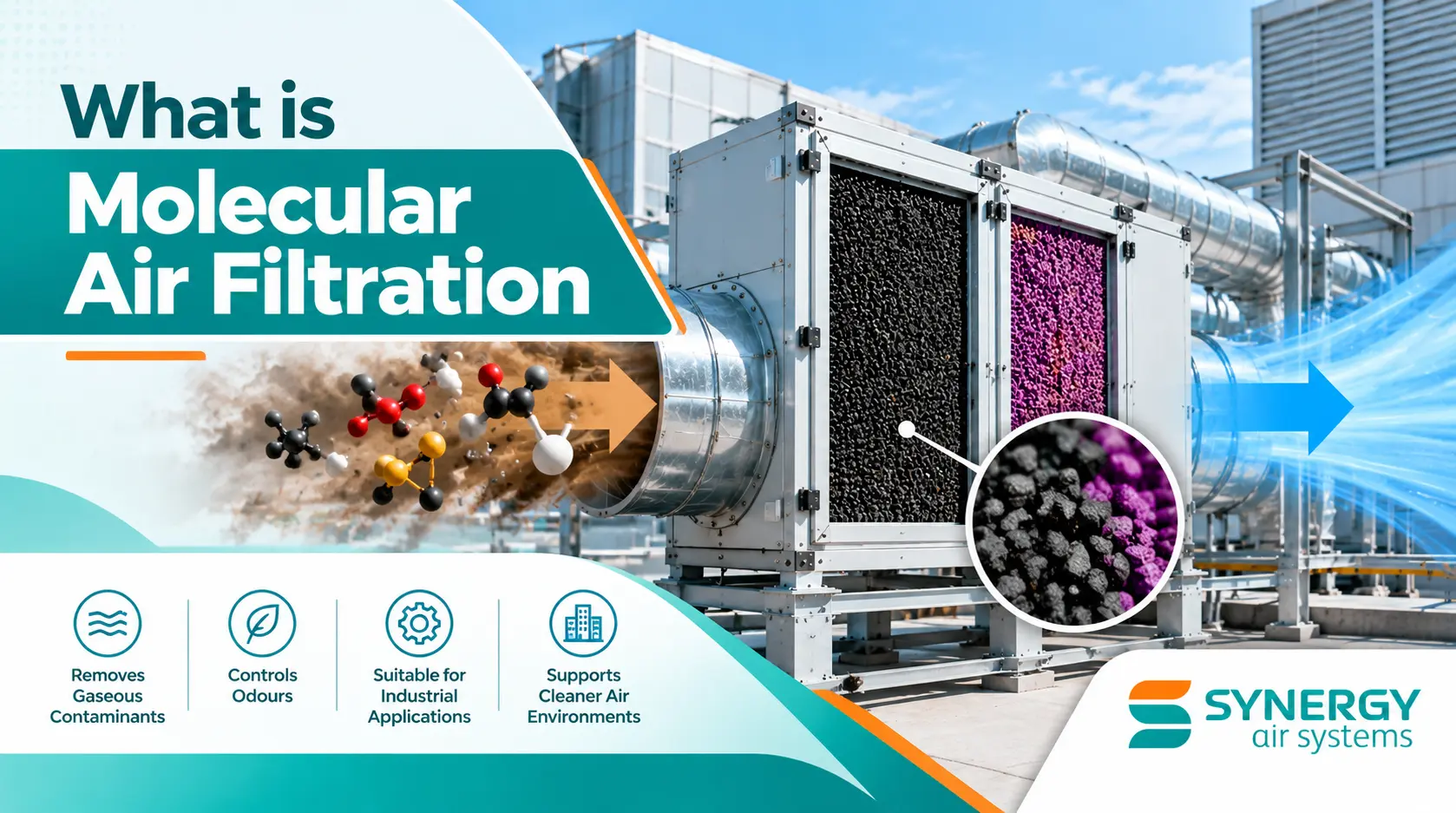
Gas phase filtration treats gaseous contaminants at the molecular level rather than relying on conventional particulate filtration.
This can be particularly relevant where corrosive or odorous gases could affect sensitive equipment, electrical rooms, control systems or occupied environments.
Synergy Air Systems states that its gas-phase filtration offering uses molecular dry-scrubbing and chemisorption media for gases including H₂S, SO₂ and chlorine, with applications including critical industrial environments and corrosion control.
Its published chemical-media information also describes different media selections for H₂S, VOCs, ammonia and other target gases, highlighting the importance of matching media to the contaminant profile.
Odor Control for Wastewater Treatment Plants
Wastewater treatment is one of the most common applications where industrial odor control needs careful engineering.
Odor-generating locations can include:
- Inlet channels
- Screening areas
- Grit chambers
- Equalisation tanks
- Wet wells
- Sludge holding areas
- Sludge dewatering zones
- Pumping stations
- Waste handling areas
The first step is usually source containment. If contaminated air is allowed to escape freely, a downstream filter cannot capture what never enters the treatment system.
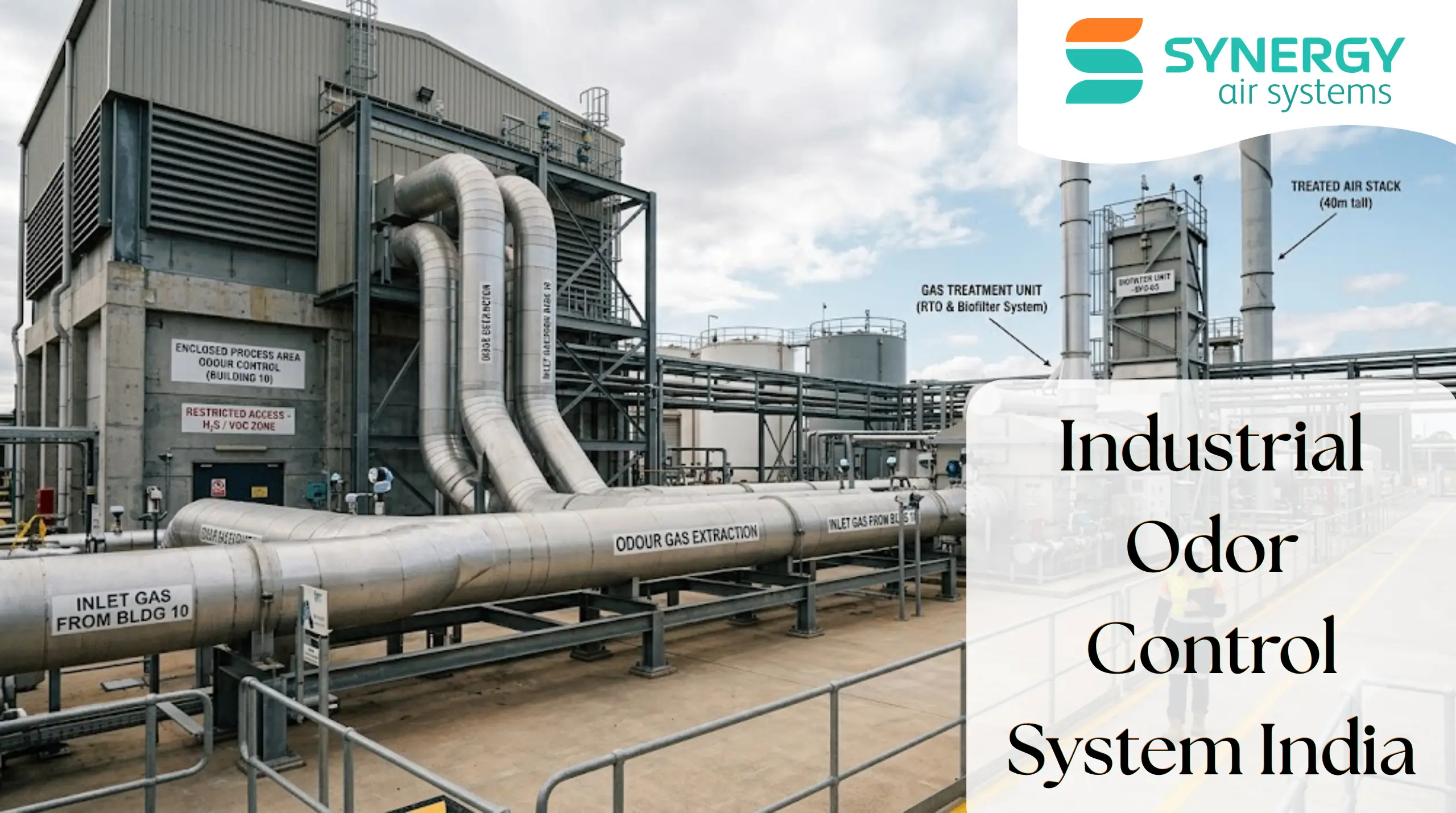
A typical strategy may therefore involve enclosing the odor source, maintaining controlled extraction and directing the collected air through a suitable treatment unit.
The treatment stage could use activated carbon, chemisorption media, biological treatment, chemical scrubbing or a combination of technologies depending on the gas composition.
CPCB and other Indian environmental documentation have highlighted H₂S generation from anaerobic wastewater and sludge conditions, reinforcing the importance of addressing both the source and the extracted air.
Odor Control for Food Processing Plants
Food-processing facilities can have highly variable odor profiles.
Odors may originate from:
- Cooking and thermal processes
- Frying and roasting
- Fermentation
- Raw-material storage
- Waste storage
- Rendering or organic processing
- Effluent treatment
- Packaging and production areas
A food-processing plant may therefore need different solutions for different emission points.
For example, a VOC-heavy exhaust stream could require adsorption-based treatment, while a wastewater area may produce H₂S and other sulphur compounds requiring a different media or treatment technology.
Synergy Air Systems lists Food & Beverage among the industries it serves and offers gas-phase filtration as part of its broader industrial air-management capabilities.
How to Select the Right Industrial Odor Control System
Choosing an industrial odor control system in India should begin with engineering data rather than equipment selection.
Consider these factors:
1. Identify the Contaminants
Determine whether the primary gases are H₂S, NH₃, VOCs, mercaptans, acid gases or a mixture.
2. Measure or Estimate Concentration
Low-concentration gas-phase filtration and high-concentration industrial scrubbing may require very different system designs.
3. Determine Airflow
The system must be sized around the required airflow, duct resistance and treatment equipment pressure drop.
4. Assess Humidity and Temperature
Moisture and temperature can affect the performance and service life of some gas-phase media.
5. Consider the Required Treatment Level
The desired outlet condition, workplace requirement, environmental objective and sensitivity of nearby areas can influence the technology.
6. Evaluate Maintenance
Ask about media replacement, chemical consumption, biological-media management, monitoring, access and annual maintenance.
7. Consider the Total Cost of Ownership
Initial equipment price is only one part of the decision. Energy consumption, consumables, media replacement, chemicals, wastewater handling, maintenance and downtime can affect long-term operating cost.
Why Containment and Airflow Matter
An odor treatment unit works best when the contaminated air is actually captured.
This means the system should be considered as a complete chain:
Odor source → containment → extraction → ductwork → treatment → monitored discharge
If extraction is inadequate, contaminated air can escape into the plant or surrounding environment. If ductwork leaks or the system allows bypass around treatment media, the performance of the treatment stage can be compromised.
For this reason, an experienced engineering partner should evaluate the complete air path rather than simply supplying a filter housing.
What Should You Ask an Odor Control Supplier?
Before requesting a quotation, prepare as much of the following information as possible:
- Application and industry
- Odor source or sources
- Airflow in m³/h
- Temperature
- Relative humidity
- Gas concentration, where available
- Target contaminants
- Operating hours
- Available installation space
- Existing ventilation and ductwork
- Required treatment objective
- Maintenance preferences
- Site and safety requirements
This information allows suppliers to compare technologies and size equipment more realistically.
Synergy Air Systems for Gas-Phase Filtration
Synergy Air Systems provides HVAC and gas-phase air filtration solutions for industrial and critical environments.
According to its website, the company works across HVAC, ventilation, cleanroom and gas-phase filtration applications and provides project planning, installation, commissioning and AMC support.
Its published gas-phase filtration offering includes molecular filtration, chemical media, emergency gas scrubbers, deep-bed scrubbers and corrosion monitoring.
For a facility evaluating odor or corrosive-gas treatment, the important starting point is the contaminant profile and airflow. From there, the appropriate treatment approach can be evaluated rather than assuming that one technology will suit every application.
Frequently Asked Questions
What is an industrial odor control system?
An industrial odor control system captures contaminated air from an industrial source and treats gases responsible for unpleasant or potentially harmful emissions. Depending on the application, treatment can use activated carbon, biofiltration, chemical scrubbing, chemisorption or a combination of technologies.
Which technology is best for industrial odor control?
There is no single best technology for every application. Activated carbon, biofilters, chemical scrubbers and gas-phase filtration have different operating principles. The appropriate choice depends on contaminants, concentration, airflow, humidity, temperature and required treatment performance.
Is activated carbon suitable for H₂S removal?
Activated carbon can be used for H₂S control when the selected media is appropriate for the concentration and operating conditions. Specially treated or impregnated media may be selected for particular gases. Media selection should be based on the actual gas profile rather than using generic carbon.
Can a biofilter remove industrial odor?
A biofilter can treat certain biodegradable odorous compounds by using microorganisms in a biological media bed. It is more suitable for applications where the contaminant profile and operating conditions support biological treatment.
When should a chemical scrubber be used?
Chemical scrubbers can be appropriate for gas streams where contaminants can be absorbed or chemically reacted with a scrubbing liquid. They may be considered for higher-concentration or chemically specific applications, subject to suitable process design and chemical-management requirements.
What gases are commonly associated with wastewater odor?
H₂S and NH₃ are among the important odorous gases associated with wastewater and waste treatment. VOCs and other sulphur-containing compounds can also contribute to complex odor profiles.
How does gas-phase filtration differ from a normal air filter?
A conventional particulate filter is designed to capture particles. Gas-phase filtration is designed to remove gaseous contaminants using adsorption, chemisorption or related molecular treatment processes. Synergy Air Systems describes its gas-phase systems as molecular dry-scrubbing solutions for gases such as H₂S, SO₂ and chlorine.
What information is needed to size an odor control system?
Important design inputs include airflow, contaminant type and concentration, temperature, humidity, operating hours, required treatment level and available installation space. Accurate information improves the basis for equipment and media selection.
Can one system treat multiple odorous gases?
Yes, multi-stage or hybrid systems can be designed for multiple contaminants. The media and treatment sequence should be selected according to the gases present and their concentrations. Synergy Air Systems notes that dual-media and custom media configurations can be used for specific gas profiles.
Conclusion
Selecting an industrial odor control system in India requires more than choosing the lowest-cost filter. Industrial emissions can contain H₂S, NH₃, VOCs and other gases, and each contaminant behaves differently.
For wastewater treatment plants, food-processing facilities and other industrial operations, an effective strategy normally starts with identifying the source, containing the contaminated air and determining the gas composition. Technologies such as activated carbon filters, biofilters, chemical scrubbers and gas phase filtration can then be evaluated against the operating conditions.
For facilities planning a new installation or upgrading an existing system, an application-specific engineering assessment can help determine the appropriate technology, airflow, media and maintenance strategy.
Table of Contents
Toggle