
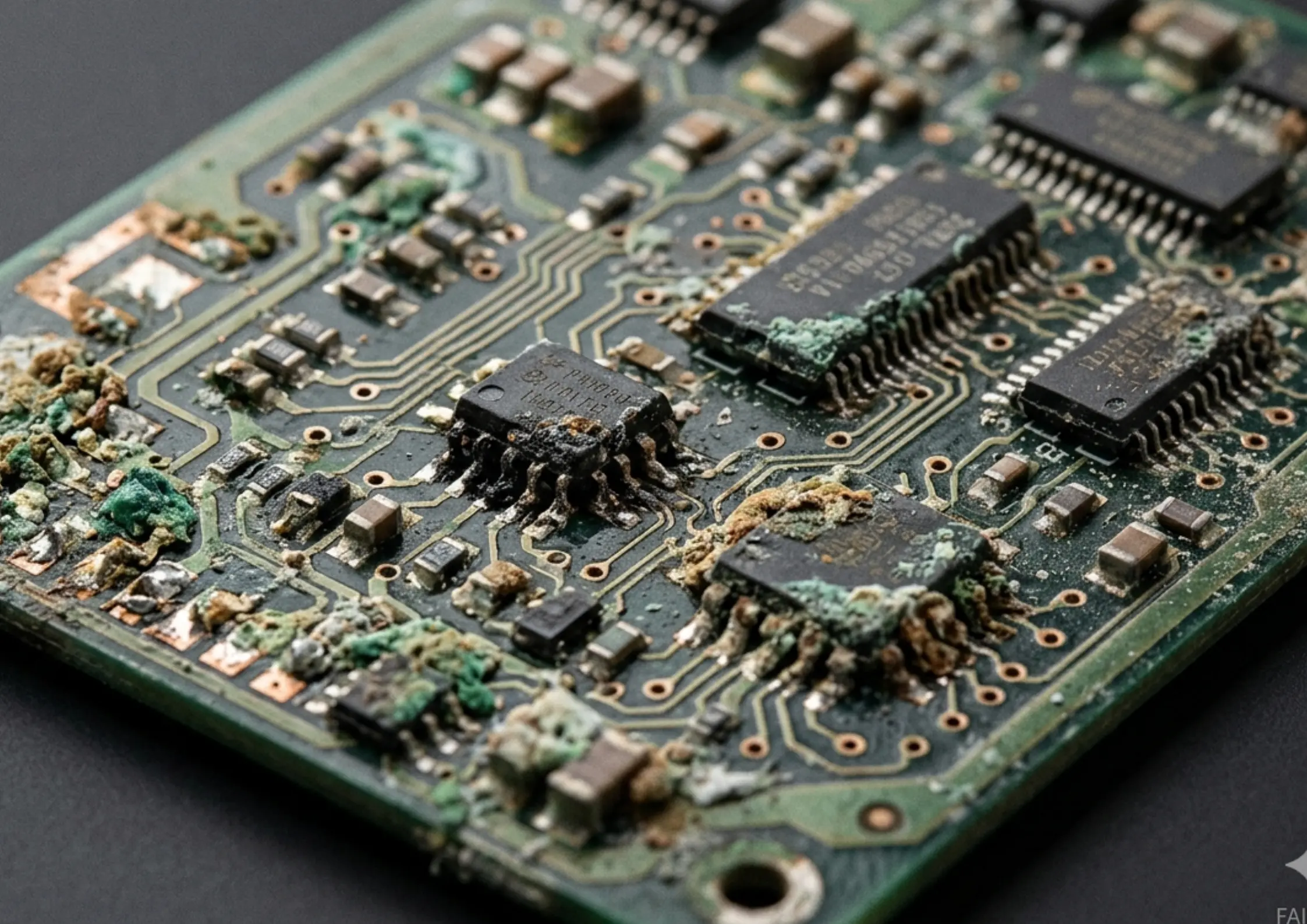

Environmental Toxin Assessment & Continuous Corrosion Monitoring

Environmental Toxin Assessment & Continuous Corrosion Monitoring – Scientific Diagnostics for Industrial Air Quality

You cannot protect against what you have not measured. In industrial environments, the airborne chemicals destroying your electronics are invisible, odourless at sub-ppm concentrations, and entirely undetectable by any human sense. Yet at just 10 parts-per-billion of H₂S, copper corrosion in your DCS already begins. By the time a hardware failure occurs, months of invisible damage have already compounded.

Synergy Air Systems provides rigorous, science-based environmental assessment services from initial baseline surveys using internationally standardized corrosion coupons to continuous real-time monitoring using Quartz Crystal Microbalance (QCM) technology. We give your engineering, reliability, and EHS teams the quantified, instrument-backed data they need to make confident decisions about protecting critical assets.

Why Measurement Comes Before Filtration

Many facilities install air filtration systems based on assumptions “we’re near a sulfur unit, so we probably need filtration.” This approach leads to two common and costly errors:

Under-specification: Installing a system with insufficient media capacity for the actual gas load, leading to early media breakthrough and unprotected periods between maintenance cycles.

Over-specification: Installing an oversized, expensive system in an environment that may already be in ISA Class G1 wasting capital that could be deployed elsewhere.

The correct approach: measure first, design second. Our assessment services provide the quantified contamination data that makes system design accurate and defensible.

Our Environmental Assessment & Monitoring Services

1. Corrosion Classification Coupon Deployment (ANSI/ISA 71.04-2013)

Corrosion classification coupons are the internationally standardized method for quantifying the severity of airborne contamination in electronic equipment environments. The method is simple, rigorous, and directly referenced in ISA Standard 71.04-2013.

How it works:

  • Precision-polished copper and silver metal coupons (99.99% pure, to ANSI/ISA specification) are mounted in a purpose-built holder and placed within the environment to be assessed typically at DCS/PLC rack height, in the return air plenum, and near known ingress points
  • Coupons are exposed for a standardized 30-day period at normal operating conditions (HVAC running, normal personnel occupancy, representative process conditions)
  • After 30 days, coupons are carefully removed and sent to an accredited metallurgical laboratory for Auger Electron Spectroscopy (AES) analysis measuring corrosion film thickness in Ångströms (Å)
  • Results are mapped against the ISA 71.04-2013 classification table to assign a definitive environmental class: G1, G2, G3, or GX

What the results tell you:

  • Your current ISA class and whether you are within equipment manufacturer specifications
  • Whether an existing filtration system is performing adequately
  • The rate of corrosion progression if no action is taken
  • The starting point for system design (required removal efficiency to achieve G1)

Synergy Air Systems manages the complete process coupon procurement, site deployment, collection after 30 days, laboratory submission, and interpretation of results in a formal written report with recommendations.

2. Airborne Gas Concentration Mapping

Knowing your ISA class tells you how much corrosion is occurring. Identifying the specific gases responsible tells you which media to deploy and how much capacity you need. We conduct comprehensive gas surveys using:

Passive Diffusion Sampling: Stainless steel or glass diffusion tubes are deployed at multiple locations throughout the facility for 7–30 days. Laboratory analysis quantifies concentrations of H₂S, SO₂, NOx, NH₃, Cl₂, HF, organic acids, and VOCs in μg/m³ or ppb. Ideal for establishing spatial contamination maps across large facilities.

Active Real-Time Sampling: Direct-reading electrochemical and photoionization instruments (PID, electrochemical sensors) provide immediate concentration readings useful for identifying peak concentration events, tracking fugitive emissions, and correlating process operations with indoor air quality spikes.

Indoor/Outdoor Ratio Analysis: Comparing outdoor ambient concentrations to indoor (control room) concentrations quantifies the infiltration factor how effectively (or ineffectively) the current building envelope and HVAC system is excluding outdoor contaminants. This directly informs pressurization design.

3. Real-Time QCM Corrosion Monitoring

Quartz Crystal Microbalance (QCM) technology represents the state of the art in continuous environmental monitoring for electronics protection. A QCM sensor works by measuring the change in resonant frequency of a vibrating quartz crystal as a microscopic corrosion film accumulates on its polished metal (copper or silver) surface.

The key advantage: A QCM sensor can detect a corrosion film of less than 1 Ångström thousandths of the film thickness that would cause any visible change. It provides a continuous, real-time, quantified measure of the corrosivity of the environment, updated every few minutes, 24 hours a day.

Our QCM monitoring systems provide:

  • Continuous ppb-equivalent corrosion rate data streamed to your DCS, BMS, or plant historian via Modbus TCP or 4-20mA output
  • Simultaneous monitoring of temperature, relative humidity, differential pressure (room vs. outside) in a single instrument
  • Alarm outputs when corrosion rate exceeds G1 threshold giving maintenance teams warning before ISA class degradation affects hardware
  • Trending data for long-term environmental analysis identifying seasonal variations, process upsets that spike corrosivity, or gradual media degradation trends

Where QCM monitoring is most valuable:

  • Post-filtration system commissioning confirming G1 achievement and ongoing compliance
  • Continuous validation at facilities where regulatory or insurance requirements mandate documented environmental classification
  • Early warning for media replacement QCM trends indicate media breakthrough before downstream hardware damage occurs

4. Filtration System Performance Audits

For facilities with existing gas-phase filtration installed, we conduct independent performance audits to verify:

  • Whether the installed system is achieving ISA Class G1 on a sustained basis
  • Whether media is approaching saturation (and when replacement should be scheduled)
  • Whether changes in plant operations, HVAC modifications, or building envelope deterioration have altered the contamination load the system must handle
  • Whether original system design specifications are still appropriate for current conditions

Audit deliverables include: Current ISA classification, media remaining life estimate, system adequacy assessment, and recommendations for upgrades or media replacement scheduling.

Deliverables – What You Receive

Every assessment engagement concludes with a formal written report containing:

  • Laboratory coupon analysis results with ISA class determination and measurement uncertainty
  • Gas concentration survey data by location, species, and concentration
  • Photographic documentation of coupon deployment locations and condition
  • ISA class trend analysis (if repeat surveys have been conducted)
  • Risk assessment – probability of hardware failure at current corrosion rates
  • Filtration system recommendations with sizing parameters, media types, and estimated system cost
  • QCM monitoring specification (if continuous monitoring is recommended)

Need to Assess Corrosion Risks in Your Facility?

Understanding your airborne contamination levels is the first step toward protecting critical equipment and improving long-term reliability. Our engineers perform environmental assessments using corrosion classification coupons and continuous monitoring technologies to help identify risks and recommend the most appropriate protection strategy.

Frequently Asked Questions

How much does a corrosion assessment cost?

A standard 30-day coupon deployment covering one control room, including laboratory analysis and written report, is a straightforward engagement. Contact us for a quotation based on the number of assessment points and locations required.

Yes, and this is the preferred approach. Coupon tests should be conducted under normal operating conditions to capture representative contamination levels. Shutdown conditions will give artificially low readings.

For facilities without continuous QCM monitoring, we recommend annual coupon testing. For facilities where a previous test showed G2 or worse classification, quarterly testing is advisable. Once a gas-phase filtration system is installed and confirmed G1, annual verification is typically sufficient.