
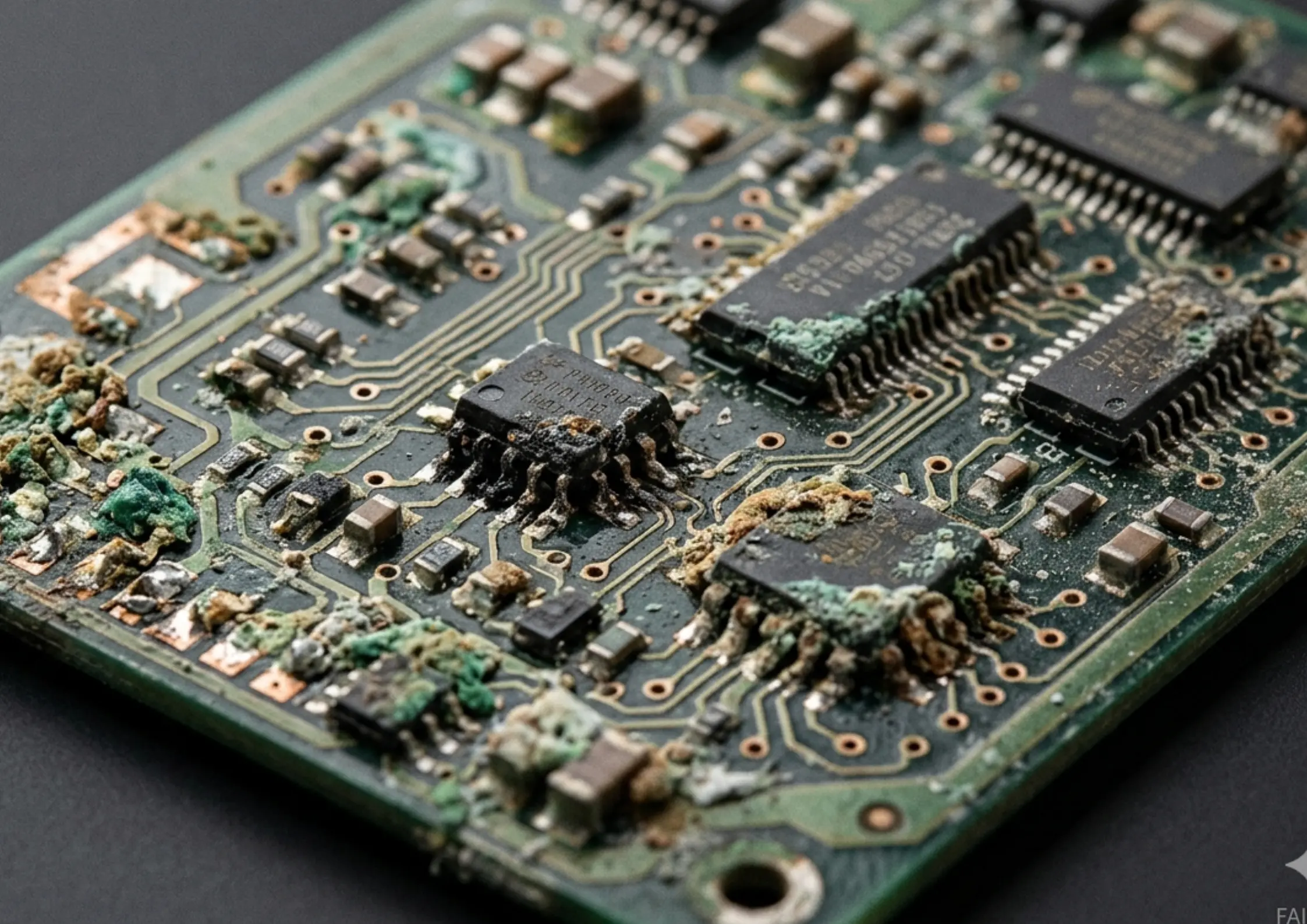

Inside your control room, tens of millions of rupees worth of mission-critical electronics silently run your entire plant. Distributed Control Systems (DCS), Programmable Logic Controllers (PLCs), Human-Machine Interfaces (HMIs), and Motor Control Centres (MCC) form the central nervous system of your operation. And they are under invisible, continuous attack.
Airborne hydrogen sulfide (H₂S), sulfur dioxide (SO₂), chlorine (Cl₂), and nitrogen oxides (NOx) present in trace parts-per-billion concentrations in industrial environments cause sulfur-driven electrochemical creep corrosion on copper and silver contact surfaces. This corrosion builds imperceptibly over months, until a relay fails, a signal card malfunctions, or a power supply shorts triggering unscheduled shutdowns that cost lakhs per hour in lost production.
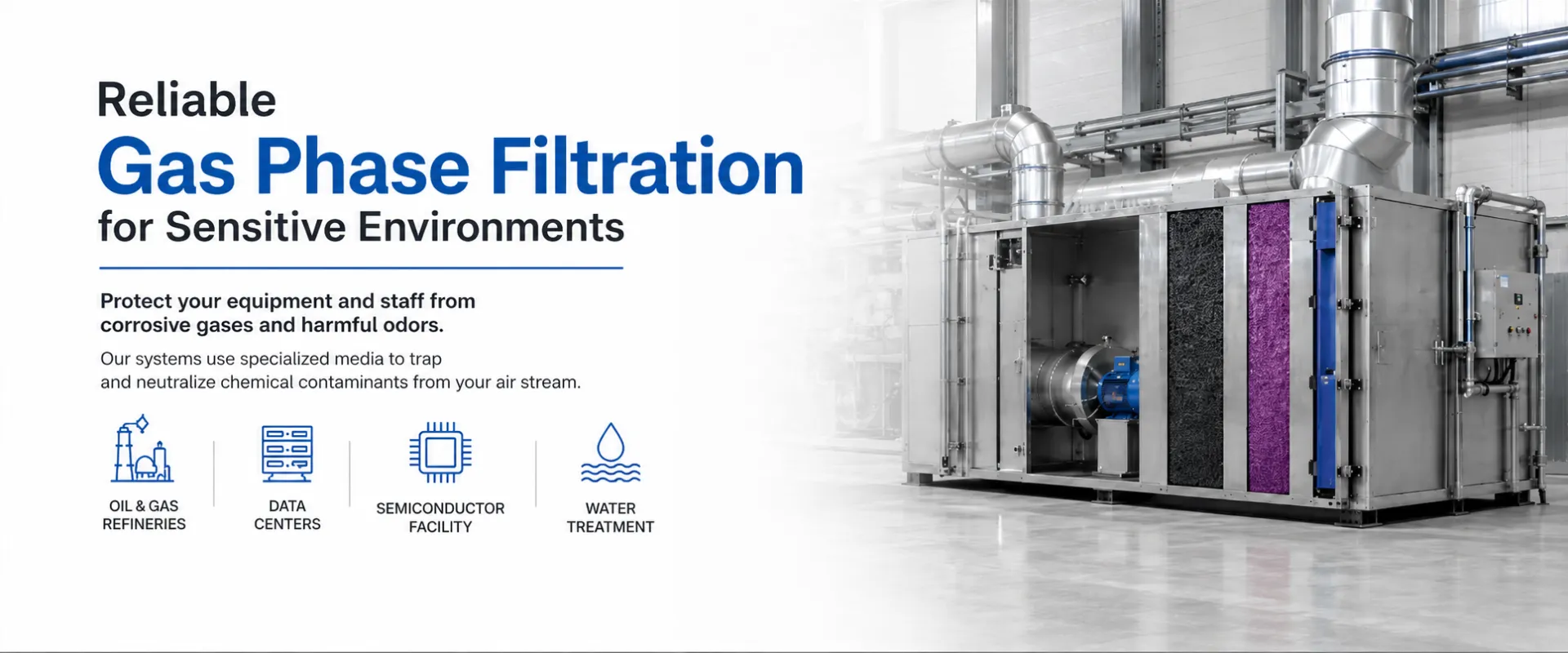
Synergy Air Systems designs, installs, and commissions precision gas-phase air filtration systems that maintain your control room at ISA Standard 71.04-2013 Class G1 (Mild) the international benchmark for electronics-safe air quality. We don’t just install filters. We eliminate the root cause.
Creep corrosion is a well-documented failure mechanism in industrial electronics. Unlike rust on steel, it is not visible to the naked eye until significant damage has occurred. Here is how it works:
Step 1: Airborne sulfur compounds (H₂S, SO₂, COS) penetrate the control room through HVAC intakes, door gaps, cable transit openings, and pressurization failures.
Step 2: These gases react with copper conductors and silver relay contacts on PCBs, forming copper sulfide (Cu₂S) and silver sulfide (Ag₂S) films.
Step 3: These sulfide films are electrically conductive and physically migrate (“creep”) across circuit board surfaces, bridging solder joints, vias, and SMD component pads.
Step 4: The result: intermittent signal faults, card failures, relay malfunctions, and catastrophic hardware failure often with no obvious physical cause during post-failure inspection.
Industries where creep corrosion is most destructive: Oil & Gas refineries, Fertilizer plants, Paper & Pulp mills, Wastewater treatment facilities, Copper & aluminium smelters, Rubber & tyre manufacturing, Coastal power plants, and Semiconductor fabrication facilities.
The ISA Standard 71.04-2013 (formerly ISA-71.04-1985) classifies the severity of airborne contaminants in environments housing electronic equipment across four levels:
| ISA Class | Reactivity Level | Copper Corrosion Rate | Silver Corrosion Rate | Risk |
|---|---|---|---|---|
| G1 – Mild | Negligible | < 300 Å/month | < 200 Å/month | Electronics safe |
| G2 – Moderate | Measurable | 300–1000 Å/month | 200–1000 Å/month | Moderate risk |
| G3 – Harsh | High | 1000–2000 Å/month | 1000–2000 Å/month | High risk |
| GX – Severe | Extreme | >2000 Å/month | >2000 Å/month | Unacceptable |
Our goal: engineer your control room environment to sustained ISA Class G1 performance. This is the only level at which DCS and PLC manufacturers provide full warranty validity and mean-time-between-failure (MTBF) guarantees.
Before designing any system, we scientifically establish your existing contamination level:
This baseline defines your current ISA class and the target removal efficiency required from the filtration system.
The first and most critical line of defense is maintaining the control room at a positive pressure differential relative to adjacent plant areas. Our engineers design:
A properly pressurized control room means plant air never enters passively. The filtered supply system is the only air source.
For control rooms with existing contamination or high gas ingress rates, recirculation scrubbing units continuously clean the room air in a closed loop. Our systems include:
For new control room builds or major HVAC retrofits, we integrate gas-phase molecular filtration directly into the fresh air makeup unit:
The most reliable method is a 30-day coupon test per ANSI/ISA 71.04. However, early warning signs include unexplained card failures, intermittent signal faults on aging PCBs, discolored copper contacts on relay terminals, and higher-than-expected hardware replacement rates. Contact us for a free preliminary assessment.
Yes. We regularly retrofit gas-phase filtration as a standalone recirculation unit (no ductwork changes needed) or as a filter bank inserted into the existing HVAC supply duct. Most retrofits are completed within 2–3 working days with zero control room shutdown.
Media life depends on contaminant concentration and airflow. Typical replacement intervals are 12–24 months in moderate industrial environments and 6–12 months in high-concentration areas (refineries, fertilizer plants). We provide media consumption modelling at the design stage and offer annual media replacement contracts.
Yes. Most major DCS suppliers (Honeywell, Yokogawa, ABB, Siemens, Emerson) explicitly state in their installation guidelines that the operating environment must comply with ISA 71.04-2013 Class G1. Operating outside these limits can void equipment warranties and reduce MTBF significantly.
WhatsApp us